This volume is part of the Practical Guide Series developed and published by the ISA, the International Society for Measurement and Control. The Practical Guides were conceived because of a shortage of published material in the field of measurement and control that bridges the gap between theory and actual industrial practice. Many books in the field have catered to the needs of technical students, who need to be oriented to basic control theory and concepts, or college-level readers, who are interested in engineering mainly from a classroom perspective. There are handbooks for practicing engineers that cover measurement and control, but these handbooks often devote only a chapter or two to topics that merit more attention. Within the Practical Guides Series, separate volumes address each of the important topics and give them comprehensive, book-length treatments. Each book in the series can be understood and used by technical students, sales engineers, sales personnel, and managers, and relied upon by those who have "real-live" industrial concerns such as correct application, safety, installation, and maintenance. Another unique feature of the Practical Guides is the stress placed on the actual experience of measurement and control practitioners. The Practical Guides are overseen by various Volume Editors and a Series Technical Editor, who have extensive experience in measurement and control. The Volume Editors have been selected for their specific expertise in the volume topics, and bring together numerous Contributing Writers with even more specialized knowledge. The Series Technical Editor, who is responsible for general technical consistency within each volume and across all volumes, helps guide the Volume Editors. The Practical Guides capture the hard-earned experience of the writers and, by employing examples and recording anecdotal observations, make that experience as applicable for the reader as possible. Case studies, either hypothetical or based on real case histories, are used to illustrate typical situations and show how good planning and practical applications made the difference between success and failure. Some of this information has never been documented before. This volume is designed to be at home in a library, in a classroom, or on the plant floor. The comfortable reading style, large pages, and frequent illustrations will contribute to ease of use. The page design uses graphics to "call out" some of the major points of the text, such as crucial safety checks and important examples. Each Practical Guide gathers widely scattered information in a single text, with bibliographies directing the reader to other sources. |
 TABLE OF CONTENTS
 Chapter 1 - Introduction to Control Valves
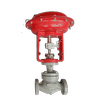
A control valve is a variable restriction, which is capable of being modulated, in a conduit that contains a flowing fluid. ISA S75.05 offers a more formal definition: "A control valve is a power operated device which modifies the fluid flow rate in a process control system. It consists of a valve connected to an actuator mechanism that is capable of changing the position of a flow controlling element in the valve in response to a signal from the controlling system" [Ref. 1]. This definition, a distillation of several other formal definitions, is extremely broad, even including off-on valves. A narrower spectrum of valves, namely, throttling control valves, is discussed on the following pages. The control valve is integral to, and inseparable from, the control system [Ref. 2]. Control begins when the valve is actuated. The valve is chosen to be reasonable in cost, require minimum maintenance, use the least amount of energy, and be compatible with the control loop. Even though the valve typically is the most expensive component of the control system [Ref. 3], it often receives less attention during the design stage than any other system component [Ref. 4]. Yet it is the item most likely to cause process downtime if it malfunctions. Thus, well-selected valves, properly installed, are critical to the well-being of the process. Control valve manufacture is a stable $2 billion-per-year industry. It was a "slow moving, sleepy" business from 1950 to 1980 [Ref. 5]. Then the rotary valve, with its ancillary components, grew from some 1% to 50% of the business [Ref. 6]. The butterfly valve was the first of the rotary configurations to be automated. Early butterfly control valves had underpowered actuators and were deemed unreliable. Realization of the torque demand relationship shown in Figure 1-1 led to the applications of limits on the degree of opening and the use of more powerful actuators, and the valves began to perform acceptably as final control elements. Rotary valves offer cost incentives and, in many cases, performance advantages over linear motion designs. Their "straight-through" configuration has higher flow capacity (Cv) but also introduces high pressure recovery with the subtle phenomena of choking and cavitation. While they offer substantial weight and dimension advantages [Ref. 6], the rotary valves have more restricted operating pressure and temperature ranges than do globe valves [Ref. 7]. Further, the flangeless models can bind with improper, uneven tightening of the flange bolts or misalignments of the pipe.  Control valve selection has traditionally been made according to primary criteria such as pressure rating, flow range, and pressure drop. The increasing emphasis on plant cost requires that today's valves must also offer minimum capital cost and minimum operating cost as well as efficient control characteristics [Ref. 8]. Secondary criteria include leakage, flow characteristic, temperature, viscosity, abrasion, and corrosion [Ref. 9]. High recovery (rotary) valves require that choked flow and cavitation be considered for process conditions in which a standard globe body would be satisfactory. Environmental regulations dictate maximum allowable noise levels. Finally, the valve actuator must be chosen [Ref. 7], and the need for a positioner determined. Determining the size of the control valve, know as valve sizing, depends on the venerable parameter Cv. Valve manufacturers' catalogs will all list valve capacities at 1 psi pressure drop in terms of Cv The concept of Cv was developed many years ago using water at reasonable temperatures flowing through a globe-type valve. Extreme conditions of the flowing fluid and advances in valve body configurations have necessitated a number of "correction" factors to modify the basic calculation for Cv These factors compensate for such things as body and piping geometry, fittings, pressure recovery, and Reynolds number. Driskell codified these factors [Ref. 10], and they now appear as a part of the ISA 75 series of standards on control valves. |