PEM Fuel Cells: Theory and Practice

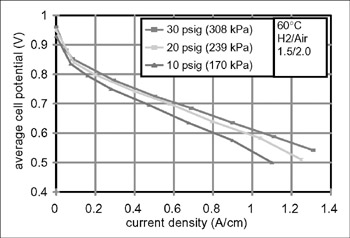
A fuel cell may be operated at ambient pressure or it may be pressurized. As we have already learned, a fuel cell gains some potential when the pressure is increased (Figure 5-1 for example), but as illustrated in Chapter 9, the net gain, when the compression power is taken into account, is at least questionable. The issue of pressurization is also related to the issue of water management, and therefore must be addressed from a system perspective.
When a fuel cell is fed the reactant gases from a pressurized tank, its pressure is controlled by a backpressure regulator placed at the outlet (Figure 5-2a). This pressure regulator keeps the desired, preset pressure at the fuel cell outlet. Very often, in laboratory settings, the inlet pressure is not even recorded. The inlet pressure is always higher because of inevitable pressure drop in tiny channels inside the fuel cell. However, when the reactant gas (for example, air) is fed to a fuel cell by a mechanical device, a blower or a compressor, which is the case in any practical system, it is the inlet pressure that matters (Figure 5-2b). The compressor or the blower must be capable of delivering the required flow rate at desired pressure. The backpressure regulator may still be used to pressurize the cell, or if no backpressure regulator is used, the gas leaves the cell at atmospheric pressure. Note that atmospheric pressure may...