Refining Processes Handbook
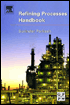
Filled with handy process flow diagrams, this comprehensive reference covers the technologies and operations of petroleum refineries and provides material on operating a jointly owned and operated refinery.
 TABLE OF CONTENTS
 Thioalcohols or thiols, more commonoly known as mercaptans, are a family of organic sulfur compounds present in a wide variety of untreated petroleum distillates, such as LPG, naphtha, kerosene, and gas oils. Specific mercaptans found in petroleum distillates originate in the crude or may form during subsequent crude refining. The concentration of these mercaptans in the crude distillate depends on the origin and sulfur distribution in the crude.
Mercaptans are undesirable in petroleum products. In the lower boiling range, they are moderately acidic and characterized by an extremely offensive odor. These properties diminish as mercaptan molecular weight increases. Thiophenol, which is an aryl mercaptan and more acidic than alkyl mercaptan, is found principally in cracked hydrocarbons. Thiophenol is undesirable in finished gasoline because it produces an unstable gasoline by promoting hydroperoxidation of olefins to gum. In summary, mercaptans are undesirable in finished petroleum products as they adversely affect the product s odor, stability, and quality, apart from being corrosive to the refining and handling equipment.
In the early days of refining industry, mercaptan removal was done with the classic Doctor solution. The Doctor treatment [1] consists of contacting the oil with a little sulfur and alkaline sodium plumbite solution, as follows:

Lead sulfide is reconverted to plumbite by heating the alkaline solution to 150 175 F and blowing with air, which converts sulfide to plumbite.
Lead sulfide itself was also used as sweetening agent. [2] The overall reaction is same as that given by the Doctor solution. The...