Strapdown Inertial Navigation Technology, 2nd Edition

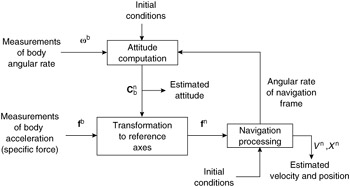
The analytical equations which must be solved in order to extract attitude, velocity and position information from the inertial measurements provided by the gyroscopes and accelerometers in a strapdown system have been described in Chapter 3. This chapter is concerned with the real time implementation of these equations in a computer. The main computing tasks, those of attitude determination, specific force resolution and solution of the navigation equation, are indicated in the block diagram shown in Figure 11.1.
The most demanding of the processing tasks, in terms of computer loading, are the attitude computation and the specific force vector resolution. In the presence of high frequency motion, the implementation of these tasks in real time creates a substantial computing burden for the strapdown system computer, even with modern processors. The navigation processing task, which is common to all types of inertial navigation system, both strapdown and platform mechanisations, is less demanding computationally. In addition to these tasks, the determination of attitude in terms of Euler rotations is required in some applications.
Early attempts to produce a strapdown inertial navigation system were limited, in part, by the computer technologies available at the time. Apart from the physical size of early computers which delayed the development of strapdown systems, particularly for airborne applications, the lack of computing speed, or throughput, was a major obstacle to the achievement of fast and accurate attitude computation. As a result, the performance which could be achieved in...