Elements of Propulsion: Gas Turbines and Rockets

With worked examples, numerous homework problems, illustrations and pictures, this book provides a complete introduction to gas turbine and rocket propulsion for aerospace and mechanical engineers.
 TABLE OF CONTENTS
 In turbomachinery, power is added to or removed from the fluid by the rotating components. These rotating components exert forces on the fluid that change both the energy and the tangential momentum of the fluid. In this section, we will develop Euler's equations for turbomachinery that relate the change in energy to the change in tangential momentum.
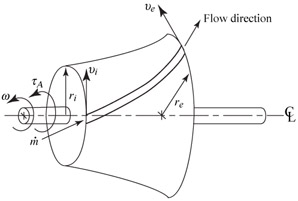
Consider the adiabatic flow of a fluid as shown in Fig. 9.1. The fluid in a stream tube enters a control volume at radius r i with tangential velocity v i and exits at r e with tangential velocity v e. For a compressor or pump with steady flow, the applied torque ? A is equal to the change in angular momentum of the fluid, or
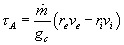
The input power is  = ? ? A, or
| (9.1) | 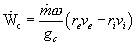 |
This equation is often referred to as the Euler pump equation. Application of the first law of thermodynamics to the flow through the control volume gives
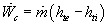
Combining this expression with Eq. (9.1) gives
| (9.2) | 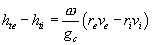 |
Likewise, for a steady-flow turbine, the output torque ? O is equal to the change in angular momentum of the fluid, or
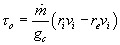
The output power is

or
| (9.3) | 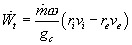 |
This equation is often referred to as the Euler turbine equation. Application of the first law of thermodynamics to the flow through the control volume gives
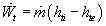
Combining this expression with Eq. (9.3) gives
| (9.4) |