Guide to Assembly Language Programming in Linux
The main objective of this chapter is to give you a brief introduction to the assembly language. To achieve this goal, we compare and contrast the assembly language with high-level languages you are familiar with. This comparison enables us to take a look at the pros and cons of the assembly language vis- -vis high-level languages.
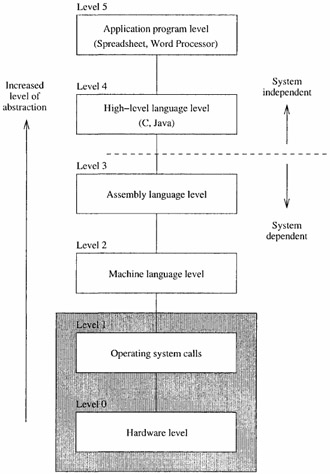
A user's view of a computer system depends on the degree of abstraction provided by the underlying software. Figure 1.1 shows a hierarchy of levels at which one can interact with a computer system. Moving to the top of the hierarchy shields the user from the lower-level details. At the highest level, the user interaction is limited to the interface provided by application software such as spreadsheet, word processor, and so on. The user is expected to have only a rudimentary knowledge of how the system operates. Problem solving at this level, for example, involves composing a letter using the word processor software.
At the next level, problem solving is done in one of the high-level languages such as C and Java. A user interacting with the system at this level should have detailed knowledge of software development. Typically, these users are application programmers. Level 4 users are knowledgeable about the application and the high-level language that they would use to write the application software. They may not, however, know internal details of the system unless they also...