MATLAB Recipes for Earth Sciences
Introducing methods of data analysis in geosciences using MATLAB, this book includes a brief description of each method and numerous examples demonstrating how MATLAB can be used on data sets from earth sciences.
 TABLE OF CONTENTS
 Multivariate analysis aims to understand and describe the relationship between an arbitrary number of variables. Earth scientists often deal with multivariate data sets, such as microfossil assemblages, geochemical fingerprints of volcanic ashes or clay mineral contents of sedimentary sequences. If there are complex relationships between the different parameters, univariate statistics ignores the information content of the data. There are number of methods for investigating the scaling properties of multivariate data.
A multivariate data set consists of measurements of p variables on n objects. Such data sets are usually stored in n-by- p arrays:
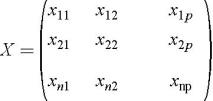
The columns of the array represent the p variables, the rows represent the n objects. The characteristics of the 2nd object in the suite of samples is described by the vector in the second row of the data array:

As example assume the microprobe analysis on glass shards from volcanic ashes in a tephrochronology project. Then the variables represent the p chemical elements, the objects are the n ash samples. The aim of the study is to correlate ashes by means of their geochemical fingerprints.
The majority of multi-parameter methods simply try to overcome the main difficulty associated with multivariate data sets. This problem relates to the data visualization. Whereas the character of an univariate or bivariate data set can easily be explored by visual inspection of a 2D histogram or an xy plot, the graphical display of a three variable data set requires a projection...