Go to GlobalSpec.com Home
Toolbar   The Engineering Toolbar
The Ultimate Resource for Engineering and Technical Research. (Learn More)

Chapter 5: Performance Characteristics

By Willem den Boer
From Active Matrix Liquid Crystal Displays

The image quality and small form factor of TFT LCDs has allowed their application in numerous portable devices as well as in desktop monitors and LCD television. This chapter first describes the basic principles of photometry and colorimetry used to characterize AMLCDs, followed by a description of the basic characteristics of standard AMLCDs in terms of viewing angle behavior, brightness, response time, size, and resolution.

5.1 Basics of Photometry and Colorimetry

Electronic displays generate images in the visible spectrum that are transferred to the eye and the brain. The visible spectrum (or light) is one form of electromagnetic radiation, with wavelengths in the range of 380 780 nm. The intensity of electromagnetic waves or photons can be expressed in radiometric units such as mW/cm 2.

The following explanation of brightness and color in displays is basic and approximate. For a much more thorough and accurate treatment, the reader is referred to one of the many excellent books on this topic [1] , [2] , [3].

The human eye is sensitive to only part of the electromagnetic spectrum (the "visible" range), as shown in the eye response (or photopic spectral luminous efficiency) curve V( ?) of Fig. 5.1. While radiometry addresses the measurement of radiation in any part of the electromagnetic spectrum, photometry focuses exclusively on the visible light range.
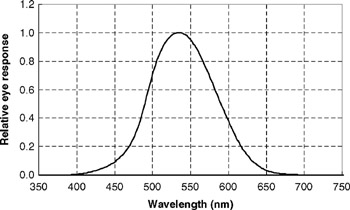

Figure 5.1: Eye response or photopic luminous efficiency curve.

The quantitative measure of display brightness is luminance Lum. It is expressed in photometric units:
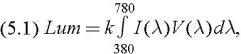

where I(

Copyright Elsevier Inc. 2005 under license agreement with Books24x7

Products & Services
Bar graph arrays are light emitting diodes (LEDs) that are used for solid state metering in applications such as audio monitoring, telecommunications, and instrumentation. Search by Specification | Learn more about Bar Graph Arrays
Infrared Sources are optoelectronic devices that emit infrared light. Learn more about Infrared Sources
Photometers produce electrical signals, which correspond to radiant flux energy, for a series of discrete wavelength intervals. They are used to measure wavelengths of light spectra and optical or atomic emissions. Search by Specification | Learn more about Photometers
Solar radiation instruments measure the spectral range of radiation, including global solar radiation (sun + sky), net radiation (incoming solar - reflected solar) and the photosynthetic light spectrum. Search by Specification | Learn more about Solar Radiation Instruments
Message LED displays are typically commercial or industrial signs. They allow for larger characters and longer viewing distances than their smaller digital cousins. Search by Specification | Learn more about LED Message Displays

Product Announcements
Solar Light Company, Inc. - Scotopic / Photopic Energy Meter
The Solar Light Model SL-3101 is a portable, innovative meter that measures scotopic and photopic energy and performs calculations. It measures spectral response following the CIE scotopic and... (read more)
Dontech Incorporated - Antiglare, antireflective coatings
Dontech engineers and manufactures a broad range of custom display filters for Contrast enhancement -- antiglare, antireflective coatings... (read more)
Solar Light Company, Inc. - Standard, Custom and OEM Light Sensors
Solar Light Company, Inc. manufactures a full range of standard, custom and OEM NIST traceable sensors and meters to meet your visible and IR light, UVA, UVB and UV germicidal measurement needs. (read more)
OSI Optoelectronics - UV Enhanced IR Suppressed Photodiodes
OSI Optoelectronics offers two distinct families of UV enhanced silicon photodiodes. Inversion channel series and planar diffused series. Both families of devices are especially designed for low noise... (read more)
OSI Optoelectronics - UV Enhanced Photodiodes
OSI Optoelectronics offers two distinct families of UV enhanced silicon photodiodes. Inversion channel series and planar diffused series. Both families of devices are especially designed for low noise... (read more)
TES Electrical Electronic Corp. - NEW ~~ TES-1339R Light Meter Pro. (RS-232)
Features: Dual Display, 4-digit LCD reading Spectral Sensitivity close to CIE photopic Curve Measuring Levels Ranging 0.01 to 999900 Lux, 0.001 to 92927 fc, Autoranging 5 step Accurate and... (read more)
OSI Optoelectronics - Blue Enhanced Photodiodes
The Photovoltaic Detector series is utilized for applications requiring high sensitivity and moderate response speeds, with an additional sensitivity in the visible-blue region for the blue enhanced... (read more)
OSI Optoelectronics - Low Noise Photodiodes
The Photovoltaic Detector series is utilized for applications requiring high sensitivity and moderate response speeds, with an additional sensitivity in the visible-blue region for the blue enhanced... (read more)

Topics of Interest
Overview Over the past 15 years, the performance of AMLCDs has dramatically improved. Depending on the requirements for a particular application, the characteristics described in the previous... (Read More)
Since it is possible to manufacture Light Emitting Diodes in a wide variety of colors and brightness, it is also necessary to accurately measure their optical characteristics. There are two ways of... (Read More)
J. Marcos Alonso, Ph.D., University of Oviedo, DIEECS-Tecnologia Electronica, Campus de Viesques s/n, Edificio de Electronica, 33204 Gijon, Asturias,Spain 22.1 Introduction Electronic... (Read More)
Colorimetry (color measurement) includes many factors such as an object's physical characteristics, the surrounding colors, the light source, and the sensor or viewer. Two spectrally different objects... (Read More)
Hugh King, Thorn Lighting 25.1 Lighting Theory 25.1.1 The Nature of Light Light is a form of electromagnetic radiation similar in nature and behaviour to radio waves at one end of the... (Read More)