The Principles of Semiconductor Laser Diodes and Amplifiers: Analysis and Transmission Line Laser Modeling

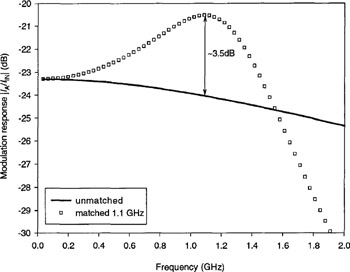
In order to check for improvement in the emitted light signal as a result of matching, the small-signal modulation responses of the laser for both the unmatched and matched cases were plotted and shown in Fig. 15.23. These results were obtained by applying the FFT to the impulse response of the integrated TLLM model, similar to the method of obtaining the frequency response of the TLM parasitics network. The results show an improvement in emitted signal of about 3.5 dB, in agreement with the results of [ [80]] for a matched laser transmitter. A resonant peak is absent for the unmatched case in Fig. 15.23 because the intrinsic laser impedance was simply modelled by a resistor ( R d) in parallel with the space-charge capacitance ( C sc) in the TLM lumped-network [ [80]].
Furthermore, the intrinsic and extrinsic relaxation oscillation frequencies were found to be 2.4 GHz and 1.5 GHz, respectively. These values were found by taking the current flowing across the intrinsic laser diode (seen as a linear load by the TLM network), and feeding it directly (i.e. within the same source code) into the nonlinear laser model (TLLM). The ?3 dB modulation bandwidth ( f-3 dB) of the laser transmitter is usually slightly higher than its relaxation frequency ( f r). However, when large electrical parasitics are present, their low-pass transfer function...