Air-Cooled Heat Exchangers and Cooling Towers: Thermal-Flow Performance Evaluation and Design, Volume II

Different types of fans find application in air-cooled heat exchangers and evaporative coolers. These fans include axial flow, centrifugal flow, mixed flow, and crossflow. When selecting a fan for a particular application, the factors usually considered are:
cost
performance (stability of operation, ease of control, power consumption, flow range)
mechanical arrangement (convenience of installation)
self cleaning blade properties
noise emission characteristics
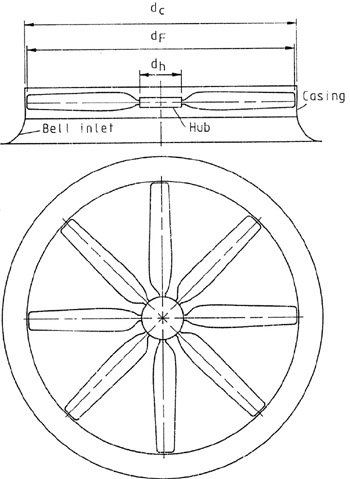
The effective operation of fans in a system may be influenced by various structural and aerodynamic factors. Numerous books on the subject have been published including those by Berry, Jorgensen, Eck, Daly, Wallis, Osborne, and Bleier. Guides for the selection of appropriate fans in specific applications are also available, such as A Guide to Fan Selection and Performance, Item No. 79037 from ESDU and Monroe's Maximising Fan Performance. In this chapter, characteristics are highlighted of axial flow fans (Fig. 6.0.1) having general application in air-cooled heat exchangers.
Modern axial flow fans have extruded aluminum or molded fiberglass blades. By nature, extruded aluminum blades are always of uniform chord width although sections may be welded onto the extrusion, while molded fiberglass blades can have any shape desired.
One of the basic criteria for blade design is to produce as uniform an air flow as possible over the entire plane of the fan. As one moves from the tip of the blade to the hub, the tangential velocity decreases. In order to produce uniform...