Broadband Telecommunications Handbook, Second Edition
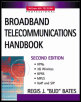
A blockbuster overview of broadband updated and expanded to reflect the latest technologies.
 TABLE OF CONTENTS
 SONET is a standard developed by the Exchange Carriers Standards Association (ECSA) for the American National Standards Institute (ANSI). This standard defines an optical telecommunications transport for U.S. Telecommunications. SONET standards provide an extensive set of operational parameters for optical transmission systems throughout the industry. The North American industry uses the SONET specifications, whereas the rest of the world uses a close cousin defined as Synchronous Digital Hierarchy (SDH), which we will discuss in the next chapter. Between the two sets of standards, the industry attempted to define the roles of transport for the telecommunications providers using optical fibers as the transport medium.
SONET provides more, though. It defines a means to increase throughput and bandwidth through a set of multiplexing parameters. These roles provide certain advantages to the industry, such as the following:
Reduced equipment requirements in the carriers' network
Enhanced network reliability and availability
Conditions to define the overhead necessary to facilitate managing the network better
Definitions of the multiplexing functions and formats to carry the lower level digital signals (such as DS-1, DS-2, and DS-3)
Generic standards encouraging interoperability between different vendors' products
A flexible means of addressing current as well as future applications and bandwidth usage
SONET defines the Optical Carrier (OC) levels and the electrical equivalent rates in the Synchronous Transport Signals (STS) for the fiber-based transmission hierarchy.
Prior to the development of SONET, the initial fiber-based systems used in the PSTN were all...