Advanced Methods and Tools for ECG Data Analysis

Haiying Wang and Francisco Azuaje
The classification of the electrocardiogram into different categories of beat types and rhythms, representing one or more underlying pathologies, is essentially a pattern recognition task. Over the past three decades computational techniques have proliferated in this field of pattern recognition. This expansion is partly due to the capability of such techniques to process large amounts of high-dimensional and noisy data in the absence of complete physiological models to assist human experts in decision making. Unsupervised learning-based approaches play a crucial role in exploratory visualization-driven ECG data analysis. These approaches are useful for the detection of relevant trends, patterns, and outliers, which are not always amenable to expert labeling, as well as for the identification of complex relationships between subjects and clinical conditions.
This chapter offers an introduction to unsupervised learning-based approaches and their application to electrocardiogram classification with emphasis on recent advances in clustering-based techniques. The application of self-adaptive neural network-based approaches for supporting biomedical pattern discovery and visualization are described. It concludes with an outlook on future trends and problems to be addressed.
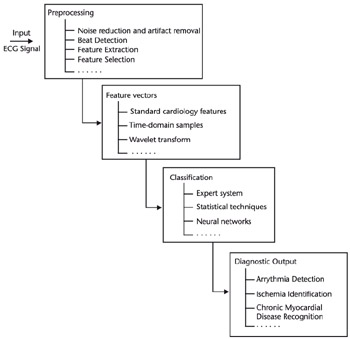
An ECG classification application typically aims to assign a given ECG recording to a physiological outcome, condition, or category based on a set of descriptive measurements. A typical computerized ECG classification process consists of several stages [1] that are illustrated in Figure 13.1.
The ECG is initially preprocessed to remove noise, detect beats, extract features, and...