Network Analysis & Circuits

Chapter 1: Introduction

1.1 WHAT IS A NETWORK?

In general terms, a network is a combination of elements. The interconnection of two or more simple elements (active and passive) is called an electrical network.

1.1.1 Active Elements

Elements, which can generate energy, are known as active elements (e.g., battery, generator).

1.1.2 Passive Elements

Elements, which cannot generate energy but can dissipate or store energy are known as passive elements (e.g., resistor, inductor, capacitor).

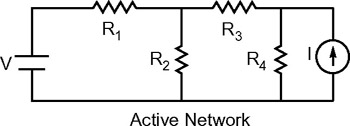
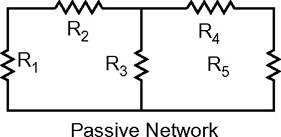
A network, which contains at least one active element, is known as an active network. A network, which does not contain any active elements, is a passive network.


Figure 1.1

Figure 1.2

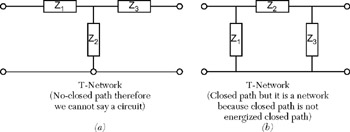
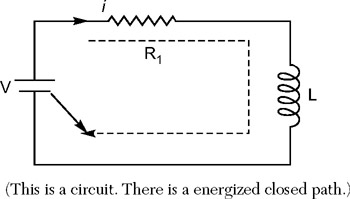
If a network contains at least one energized closed path, it is also an electric circuit. Every circuit is a network but not all networks are circuits (e.g., T-networks).

1.1.3 Unilateral or Bilateral Elements

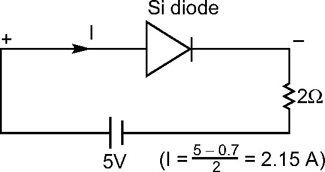
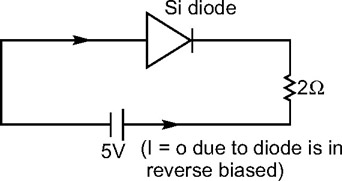
A unilateral network has different relationships with the two possible directions of current between voltage and current (e.g., diodes, SCR).


Figure 1.3

Figure 1.4: (This is a circuit. There is a energized closed path.)

Figure 1.5: Voltage, resistance, and current all exist together in a circuit

Figure 1.6: Voltage, resistance, and current all exist together in a circuit

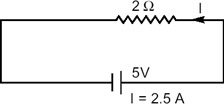
In the above example the relation between voltage and current is different. Therefore, diode is a unilateral element. A bilateral network has the same relationship between voltage and current for the two possible directions of current, e.g., R, L, C (non-polar capacitor only).

1.1.4 Linear or Non-Linear Elements

A circuit element is linear if the principle...

UNLIMITED FREE
ACCESS
TO THE WORLD'S BEST IDEAS

SUBMIT
Already a GlobalSpec user? Log in.

This is embarrasing...

An error occurred while processing the form. Please try again in a few minutes.

Customize Your GlobalSpec Experience

Category: Power Supplies
Finish!
Privacy Policy

This is embarrasing...

An error occurred while processing the form. Please try again in a few minutes.