Radar Foundations for Imaging and Advanced Concepts
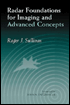
Whether you are a radar novice or experienced professional, this essential reference features the theory and practical application of formulas you use in radar design every day.
 TABLE OF CONTENTS
 Having examined how a radar signal is generated, is emitted from the antenna, scatters from external objects, reenters the radar, and is recorded as a voltage by an A/D converter, we now begin consideration of how to interpret the resulting measurement. Throughout this chapter, the returned echo is considered as a signal voltage plus a noise voltage, both analog (continuous). Effects of A/D quantization noise can be considered part of the noise voltage.
Consider this simple question: Suppose we transmit monochromatic pulses (by which we mean pulses with a single frequency, except for the inevitable bandwidth resulting from the finite pulse width), sample the return from a particular range gate, and ask, Is there a point target in the range gate?
The term detector refers to that portion of the radar receiver from the output of the IF amplifier to the input of the indicator or data processor [1, p. 382]. Detection refers to the process of deciding whether to declare the presence of a target [2]. The relationship between the signal input and the detector output may be complicated. For simplicity, this chapter considers the following detector types:
Coherent detector, which utilizes both amplitude and phase information (phase of signal is known);
Envelope detector (noncoherent detector), which samples the envelope (magnitude) of the output voltage (phase of signal is unknown).
The following relationships between envelope detector output and input may exist:
Linear...