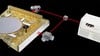
Vacuum coatings processes use a vacuum (sub-atmospheric pressure) environment and an atomic or molecular condensable vapor source to deposit thin films and coatings. The vacuum environment is used not only to reduce gas particle density but also to limit gaseous contamination, establish partial pressures of inert and reactive gases, and control gas flow. The vapor source may be from a solid or liquid surface (physical vapor deposition PVD), or from a chemical vapor precursor (chemical vapor deposition CVD). The terms "physical vapor deposition" and "chemical vapor deposition" seem to have originated with C.F. Powell, J.H. Oxley, and J.M. Blocher, Jr., in their 1966 book Vapor Deposition to differentiate between the types of vapor sources [1]. The term "vacuum deposition" is often used instead of PVD, particularly in the older literature such as Leslie Holland's classic 1956 book Vacuum Deposition of Thin Films [2]. Vacuum coatings can also be formed by deposition of molten particles in a vacuum [3], but that process will not be covered here.
In PVD processing the vaporization may be from thermal heating of a solid (sublime) or liquid (evaporate) surface or by the non-thermal (momentum transfer) process of sputtering (physical sputtering). When the depositing material reacts with the ambient gaseous environment or a co-deposited material to form a compound, it is called reactive deposition. If the vapor source is from a solid molecular species (such as silicon oxide), some of the more volatile constituents may be lost upon vaporization. If these lost species are replaced by...
Copyright Noyes Publications/William Andrew Publishing 2003 under license agreement with Books24x7


 TABLE OF CONTENTS