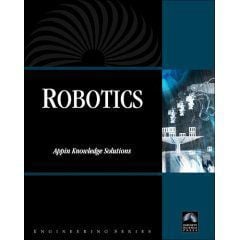
 | This up-to-date text/reference is designed to present the fundamental principles of robotics with a strong emphasis on engineering applications and industrial solutions based on robotic technology. It can be used by practicing engineers and scientists - or as a text in standard university courses in robotics. The book has extensive coverage of the major robotic classifications, including Wheeled Mobile Robots, Legged Robots, and the Robotic Manipulator. A central theme is the importance of kinematics to robotic principles. The book is accompanied by a CD-ROM with MATLAB simulations, photographs, tutorials, and third-party software (see About the CD-ROM section). |
 TABLE OF CONTENTS
 Robotics
Chapter 7 Legged Robots
In This Chapter
- Why Study Legged Robots?
- Balance of Legged Robots
- Analysis of Gaits in Legged Animals
- Kinematics of Leg Design
- Dynamic Balance and Inverse Pendulum Model
7.1 WHY STUDY LEGGED ROBOTS?
One need only watch a few slow-motion instant replays on the sports channels to be amazed by the variety and complexity of ways a human can carry, swing, toss, glide, and otherwise propel his body through space. Orientation, balance, and control are maintained at all times without apparent effort, while the ball is dunked, the bar is jumped, or the base is stolen, and such spectacular performance is not confined to the sports arena only. Behavior observable at any local playground is equally impressive from a mechanical engineering, sensory motor integration point of view. The final wonder comes when we observe the one-year-old infant s wobble with the knowledge that running and jumping will soon be learned and added to the repertoire.
Two-legged walking, running, jumping, and skipping are some of the most sophisticated movements that occur in nature, because the feet are quiet small and the balance at all times has to be dynamic; even standing still requires sophisticated control. If one falls asleep on ones feet he falls over. The human stabilizes the movement by integrating signals from:
- Vision, which includes ground position and estimates of the firmness of the ground and the coefficient of friction.
- Proprioception, that is, knowledge of the positions of all the interacting muscles, the forces on them and the rate of movement of the joints.
- The vesicular apparatus, the semicircular canals used for orientation and balance.
A very large number of muscles are used in a coordinated way to swing legs and the muscle in an engine consisting of a power source in series with an elastic connection. Various walking machines have been developed to imitate human legs, but none is as efficient as those of humans. Even the walking of four-legged animals is also highly complex and quite difficult to reproduce. The history of interest in walking machines is quite old. But until recently, they could not be developed extensively, because the high computational speed required by these systems was not available earlier. Moreover, the motors and power storage system required for these systems are highly expensive. Nevertheless, the high usefulness of these machines can discount on some of the cost factors and technical difficulty associated with the making of these systems. Walking machines allow locomotion in terrain inaccessible to other type of vehicles, since they do not need a continuous support surface, but the requirements for leg coordination and control impose difficulties beyond those encountered in wheeled robots. Some instances are in hauling loads over soft or irregular ground often with obstacles, agricultural operations, for movements in situations designed for human legs, such as climbing stairs or ladders. These aspects deserve great interest and, hence, various walking machines have been developed and several aspects of these machines are being studied theoretically.
In order to study them, different approaches may be adopted. One possibility is to design and build a walking robot and to develop study based on the prototype. An alternative perspective consists of the development of walking machine simulation models that serve as the basis for the research. This last approach has several advantages, namely lower development costs and a smaller time for implementing the modifications. Due to these reasons, several different simulation models were developed, and are used, for the study, design, optimization, and gait analysis and testing of control algorithms for artificial locomotion systems. The gait analysis and selection requires an appreciable modeling effort for the improvement of mobility with legs in unstructured environments. Several articles addressed the structure and selection of locomotion modes but there are different optimization criteria, such as energy efficiency, stability, velocity, and mobility, and its relative importance has not yet been clearly defined. We will address some of these aspects in these issues in the later sections of this chapter.
© 2006-2026 Infinity Science Press. All rights reserved.