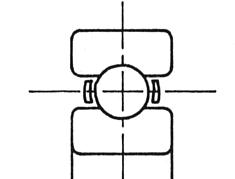
The object of ball bearings (and roller bearings) is the substitution of pure rolling motion for plain sliding friction.
Rigid single row ball bearing.- Basic type of bearing widely used. The balls run in comparatively deep grooved
tracks which make the bearing suitable for both radial (journal) load and axial thrust load. The bearing provides location
of the shaft in relation to the housing when provided with suitable means of clamping.
Rigid single row bearing with filling slots for balls.- This bearing contains more balls than the standard type and
can therefore take heavier radial loads but only limited thrust.
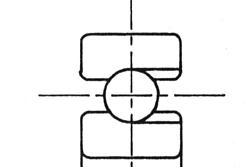
Rigid double row bearing.- For heavy radial loads and to provide greater rigidity. Requires accurate location if used
in conjunction with another bearing.
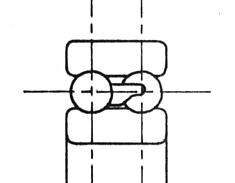
Self aligning double row bearing.- For applications in which slight deflections cannot be avoided when rotating.
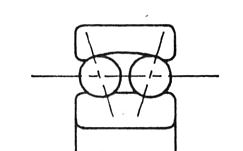
Aligning single row bearing.- This bearing will correct initial angular misalignment between shaft and housing but is
not designed to accommodate shaft deflection or misalignment when rotating.
Angular contact single row bearing.- Gives precise axial location under thrust load. May be used in pairs to
accommodate thrust in either direction.
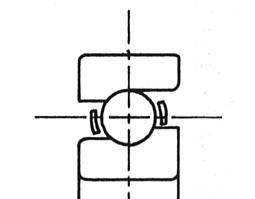
Duplex bearing.- Used to take heavy thrust in either direction and some radial load.
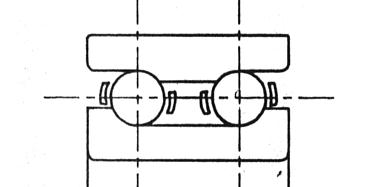
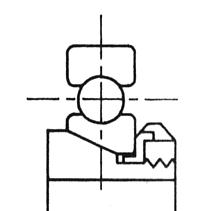
Adaption sleeve bearing.- This bearing is mounted on a tapered split sleeve to simplify assembly on long shafts etc.
Mechanical Engineering Design Topics Page - Bearing Selection Page
Pages created by David Price - 9/08/95
This Information is an educational resource and is not to be reproduced (other than for private study) without
written consent of the University of Southampton. copyright © Dave Whatley 1995
GlobalSpec.com is presenting this material with the consent of Dave Whatley.
Disclaimer Whilst every care has been taken to ensure the accuracy and completeness of this information, neither the author nor the University of Southampton will accept responsibility for loss, damage etc. however arising occasioned by the use of this information.