A tolerance is exactly as the word implies. It is the amount of deviation that can be tolerated in the SIZE and GEOMETRY of a component or assembly.
To have any chance of manufacturing components, the dimensions specified on drawings, need to show the acceptable upper and lower limits of size. Within reason, these limits should be as generous as possible in order to keep down manufacturing costs. Obviously there are times when it is necessary to quote very tight limits in order to provide a particular fit. For instance, it may be necessary for two components which fit together, to be assembled with a transition fit. On the other hand the components may need to be pressed together. Clearly the limits on the size of the components, will dictate the kind of fit obtainable. The draughtsperson producing the drawing cannot leave any dimension without a size tolerance. Most dimensions can be covered by an overall drawing tolerance, but areas where particular fits are necessary, need to be identified and given appropriate tolerances.
As a guide, the table below gives tolerances which can be achieved by various manufacturing processes.
|
Process |
Tolerance |
|
Machining - close tolerance |
± 0.1mm |
|
Machining - general |
± 0.25mm |
|
Sheet metal work (small components) |
± 0.5mm |
|
Sheet metal work (large components) |
± 1mm |
|
Hole centres and drilling |
± 0.25mm |
|
Sand casting |
± 3mm |
|
Flame cutting |
± 3mm |
|
Plasma cutting |
± 1mm |
Interchangeability is one of the major reasons for using tolerances. It is impossible to guarantee that production components will fit, without using comprehensive tolerancing on interfaces. It is necessary to be able to produce components in batches, at any time, in different locations and still be able to guarantee the fit. You imagine going to buy a spare part for your car or motor cycle and finding that it wont fit because the size is incorrect. The manufacturer must be able to rely on the tolerance specified on the drawing, in order to be able to produce fully interchangeable components, with the correct interfacing condition.
On the other hand, one off or prototype components and assemblies do not necessarily need comprehensive tolerancing. It is often sufficient to allow one component to be machined to fairly relaxed tolerances whilst specifying the mating component to be machined to a specific fit, quoting only the clearance or interference required.
It is sometimes necessary to specify that the faces of a component are flat, parallel, perpendicular to others etc. This is done on drawings by quoting a geometrical tolerance. For instance, the cylinder head on an internal combustion engine does need to be flat, where it interfaces with the crankcase (which of course also needs to be flat). It does not need to have very accurate size tolerances - normal machining tolerances will suffice, but size tolerances will not guarantee flatness. In the case of the cylinder head, it is a fairly rough casting, so there is no datum surface to relate to and there is no point in creating one. The cylinder head does not have to be parallel to anything, or perpendicular to a face, within close limits. However a flatness band has to be created, within which the surface must remain, otherwise the result could be a distorted and leaking cylinder head.
Cylindrical components may also need geometrical tolerances. Again using the internal combustion engine as an example,
the crankshaft will almost certainly need geometrical tolerances.
There are several bearing surfaces which need to be concentric with one another. The only way to guarantee concentricity
is to use one surface as a datum and use geometric tolerances, to ensure that the other surfaces do not deviate outside of the
limits specified.
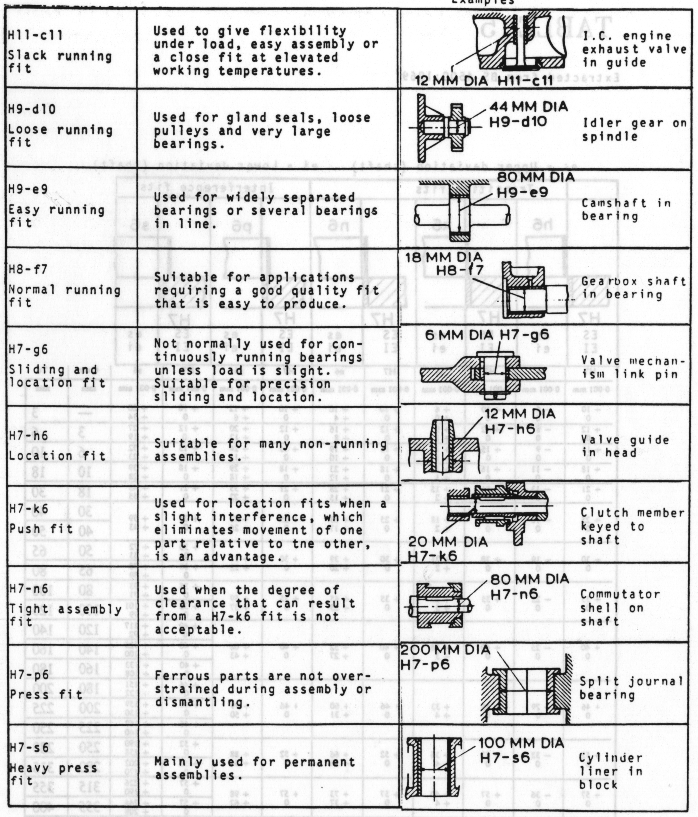
Guide to the Selection of Fits
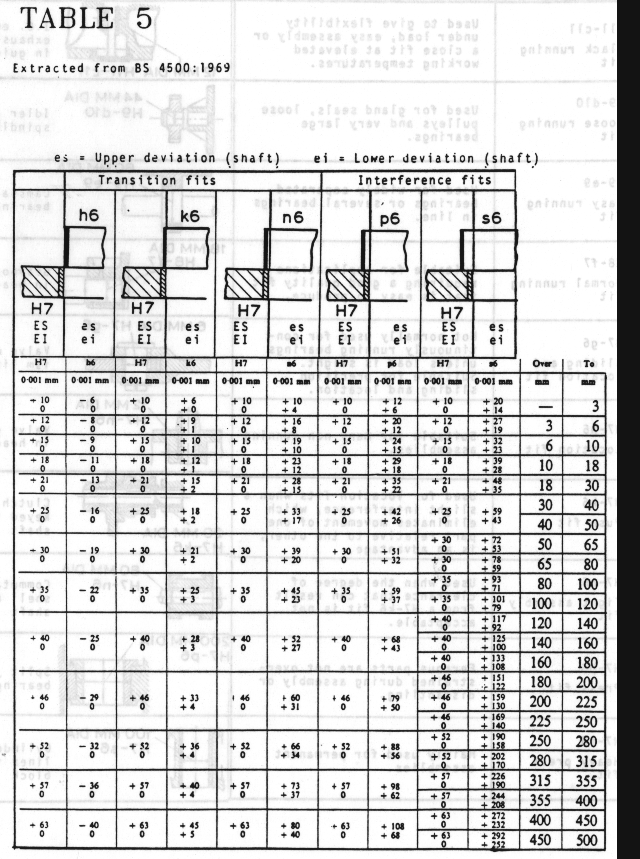
Tolerance Table (Transition/Interference fits)
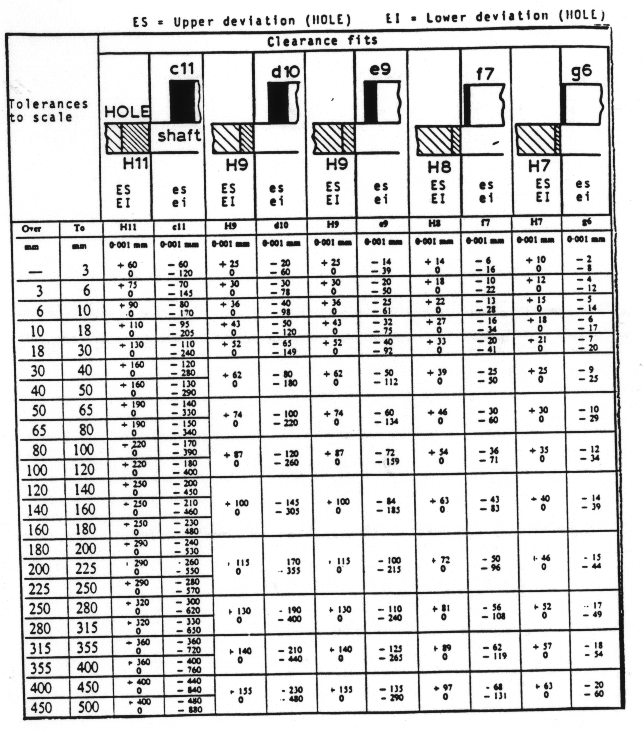
Tolerance Table (Clearance Fits)
Mechanical Engineering Design Topics Page
Pages created by David Price - 9/08/95
This Information is an educational resource and is not to be reproduced (other than for private study) without
written consent of the University of Southampton. copyright © Dave Whatley 1995
GlobalSpec.com is presenting this material with the consent of Dave Whatley.
Disclaimer Whilst every care has been taken to ensure the accuracy and completeness of this information, neither the author nor the University of Southampton will accept responsibility for loss, damage etc. however arising occasioned by the use of this information.