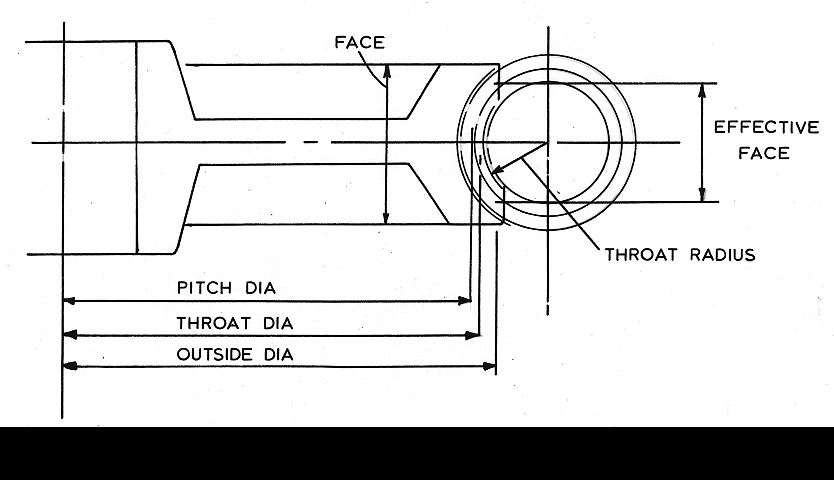
Worm gearing is used to transmit motion and power between nonintersecting shafts at right angles to one another. High gear ratios may be obtained together with a self locking action (i.e. the gears cannot easily be back driven) but at high ratios the efficiency can be as low as 40 - 50%. The worm drives by its threads sliding into contact with the teeth of the worm wheel, which results in silent running providing the gears are properly designed, manufactured and assembled. This sliding action generates heat due to friction and therefore adequate cooling and lubrication must be provided for gears which work at high velocity and load.
Number of teeth in wheel.- The total number in the complete circumference of the wheel.
Number of starts in worm.- The total in the complete circumference of the circular section.
Circular pitch.- The length of the arc from the centre of one tooth to the centre of the adjacent tooth measured on the pitch line diameter.
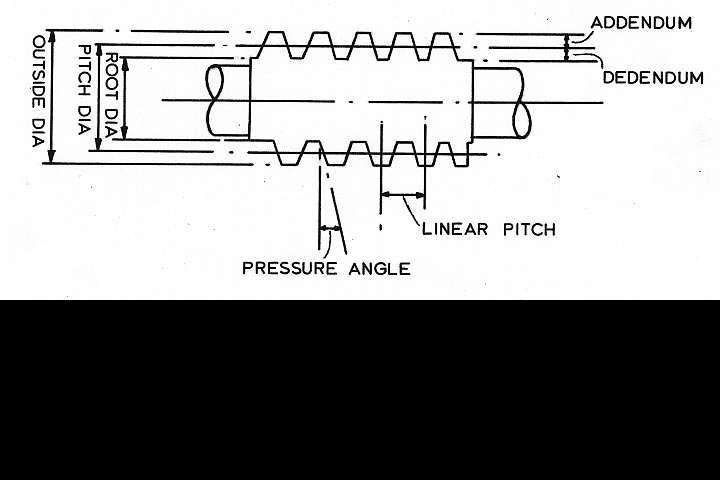
Linear pitch.- The distance from the centre of one thread to the centre of the adjacent thread measured on the line parallel with the axis.
Normal pitch.- The distance from the centre .of one thread to the centre of its adjacent thread measured on the arc of the section normal to the lead angle.
Lead angle of worm threads The angle of the threads measured from the vertical.
A wormwheel is produced by means of a cutter called a hob. These are expensive tools to produce, therefore when using worm gearing it is advisable to purchase a standard worm and wormwheel as shown in a manufacturer's catalogue. If for any reason it is not possible to purchase a worm and wormwheel to meet the requirements, the manufacturers should be consulted; they will supply details of standard hobs held in stock and a worm and wormwheel can then be designed accordingly.
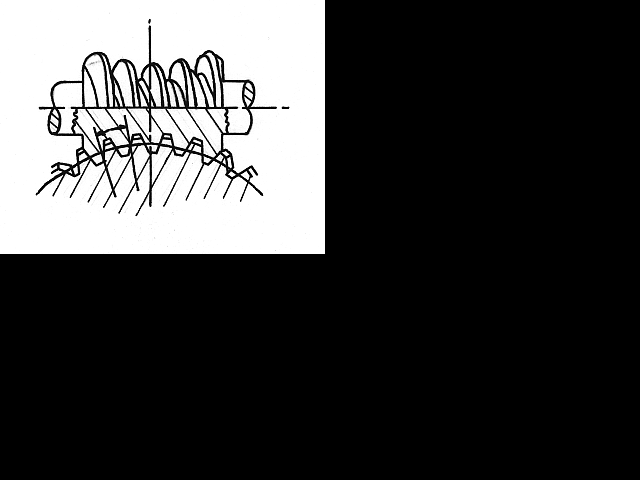
For highly loaded gears a cone worm is used. This provides contact with several teeth on the wormwheel instead of the usual one and a half tooth contact as in cylindrical worms. Cone worms are not usually supplied as standard by manufacturers and they are expensive to produce.
Materials.- Worms are usually manufactured from steel and wormwheels from bronze but steel wormwheels are sometimes used.
Mechanical Engineering Design Topics Page - Gearing Selection Page
Pages created by David Price - 9/08/95
This Information is an educational resource and is not to be reproduced (other than for private study) without
written consent of the University of Southampton. copyright © Dave Whatley 1995
GlobalSpec.com is presenting this material with the consent of Dave Whatley.
Disclaimer Whilst every care has been taken to ensure the accuracy and completeness of this information, neither the author nor the University of Southampton will accept responsibility for loss, damage etc. however arising occasioned by the use of this information.