Air-Cooled Heat Exchangers and Cooling Towers: Thermal-Flow Performance Evaluation and Design, Volume II

As in the case of banks of air-cooled heat exchangers, recirculation of hot, moist plume air is known to reduce the performance of rows of cooling tower units or cells according to CTI Bulletin PFM-110 and the British Standards Institution Code BS4485. When several banks of air-cooled heat exchangers or rows of cooling tower cells are located next to each other, the plume of one bank or row may be drawn into an adjacent one. This phenomenon is referred to as interference.
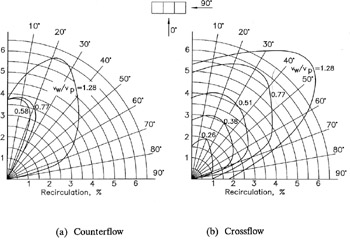
Ribier conducted recirculation tests on models of induced draft cooling towers cells similar to the types shown in Figure 1.1.3 but without a diffuser. Initial tests were conducted on a row consisting of three cells with fills in counterflow and crossflow. The results of these tests are shown in Figures 9.4.1(a) and 9.4.1(b) as a function of different wind directions and ratios of wind speed measured 10 m above ground level to plume exhaust speed, v w/ v p. The percentage recirculation is less for the counterflow arrangement than for the crossflow arrangement. When a diffuser was added to the counterflow unit, a reduction in recirculation was observed.
A further set of tests was conducted by Ribier in which two rows of counterflow cooling towers each consisting of three cells were first arranged end to end (six cells) and then systematically spaced one, two, and three cells...