Overview
To determine the performance characteristics of heat exchangers, it is essential to determine the mean temperature difference between fluids accurately. Since this difference depends on the geometry and the flow pattern through the heat exchanger, simple analytic solutions are not always possible. For computational purposes, the method proposed by Roetzel is of value.
Consider the heat exchanger shown in Figure B.1.
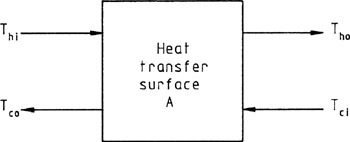 Figure B.1: Schematic of Heat Exchanger
 In such an exchanger, the heat transfer rate is given by
where
-
UA is the conductance of the exchanger
-
U is the overall heat transfer coefficient and is assumed to be constant
-
Q is the heat and flows from the hot fluid, subscript h, to the cold fluid, subscript c
According to Equation B.1, the mean temperature difference between the two streams, ? T m, may be expressed as
or, if made dimensionless with respect to the largest temperature difference,
Dimensionless temperature changes of the two streams may be defined as
and
where
| m | = | the mass flow rate |
| c p | = | the specific heat of the fluid |
In the case of counterflow, a dimensionless mean temperature difference can be expressed in terms of the logarithmic mean temperature difference, i.e.,
According to Roetzel, a temperature correction factor can be expressed as
Tables B.1 to B.10 present the sixteen values of the empirical constant a i,k for ten different heat exchanger geometries.
Table B.1: Crossflow with One Tube Row | a i,k | i = 1 | 2 | 3 | 4 |


 TABLE OF CONTENTS