Fractal Speech Processing

Including numerous applications and examples, this book offers the results of research carried out to develop novel fractal-based techniques for the analysis of speech and audio signals.
 TABLE OF CONTENTS
 A signal is defined as any physical quantity that varies with time, space or any other independent variable or variables. Mathematically, we describe a signal as a function of one or more independent variables. For example, the functions


describe two signals, one that varies linearly with the independent variable t (time) and a second that varies quadratically with t. As another example, consider the function

This signal function has two independent variables x and y, which might represent the two spatial coordinates in a plane.
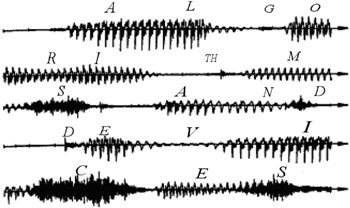
The signals described by Eqns 6.1 and 6.2 belong to a class of signals that are precisely defined by specifying the functional dependence on the independent variable. However, there are cases where such a functional relationship is unknown or too highly complicated to be of any practical use. For example, the speech signal depicted in Figure 6.1 cannot be described functionally by expressions such as in Eqn 1. In general, a segment of speech can be represented to a high accuracy as a sum of several sinusoids of different amplitudes and frequencies,

where A i( t), F i( t) and ? i( t) are the (time-varying) amplitude, frequency and phase respectively of sinusoidi i. In fact, one way to interpret the information content or message conveyed by any short-time segment of the speech signal is to measure the amplitudes, frequencies and phases contained in the short-time segment.