The Handbook of Hazardous Materials Spills Technology
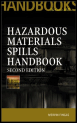
As an all-new update to the classic Hazmat reference book, this text addresses issues such as International law and regulations, risk assessment, biological effects, spill modeling, and more.
 TABLE OF CONTENTS
 Containment refers to actions taken to keep a material in its container, such as plugging or patching a leaking 55-gallon drum. Confinement refers to the procedures taken to keep a material in a defined or localized area once it has been released. Confinement is used when the chemical has breached the container and it is desirable to keep the material within defined boundaries. Confinement may be viewed as a defensive activity, and containment as an offensive activity. Through the effective use of containment and confinement, the spread of the spill or release is minimized; people, property, and the environment are protected; and cleanup and recovery operations become more efficient.
Two major points should be considered when developing containment/confinement strategies. Safety of response personnel is the primary consideration for any response action. While responders are taught to enter from an upwind, uphill, upstream position to deal with emergency situations, they may have to respond downwind, downhill, and downstream to contain/ confine a spill. Responders may be required to work in, or at least in close proximity to the material that is spilling or being released. Proper monitoring...