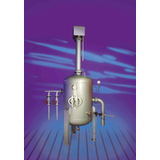
Product Description: Boiler blowdown
Steam boilers must be blown down to remove contaminants, as too high a level will cause foaming, and scaling of the boiler tubes. A build-up of solids at the bottom of the boiler could also have serious consequences. Most modern boilers are fitted with TDS controls to remove dissolved solids, and a blowdown valve that is opened at regular intervals to remove precipitated solids.
Because the bottom blowdown valve is opened once per day for just a few seconds, it is not economical to recover the heat, yet water cannot be discharged to drain unless it is cool. Nowadays, blowdown vessels have replaced blowdown pits as the recommended way of cooling this water.
Blowdown from TDS controls should ideally be connected to a heat recovery system, but where this is not practical, TDS blowdown may also be piped to a blowdown vessel.
Regulations
The key UK regulations are those issued by the Health and Safety Executive and British Standards.
The Health and Safety Executive Guidance Note PM60 states that blowdown vessels should normally be provided for all new installations instead of blowdown pits. The blowdown vessels should be constructed to PD 5500 and should be regularly inspected by a competent person such as an insurance inspector.
The implications of PD 5500 construction include design approval, material certification, independent approval of the welders and welding processes. On completion, a data dossier is prepared and issued to the customer.
Spirax Sarco blowdown vessels fully comply with all these requirements plus the requirements of the European Pressure Equipment Directive 97 / 23 / E.