
Warehouse Management Systems (WMS) Information
Warehouse management systems (WMS) are software programs that track the location of goods within a warehouse. This primarily saves storage space and eases order picking to make the warehouse more efficient. WMS support varying configurations of automated and manual material handling operations.
Operation
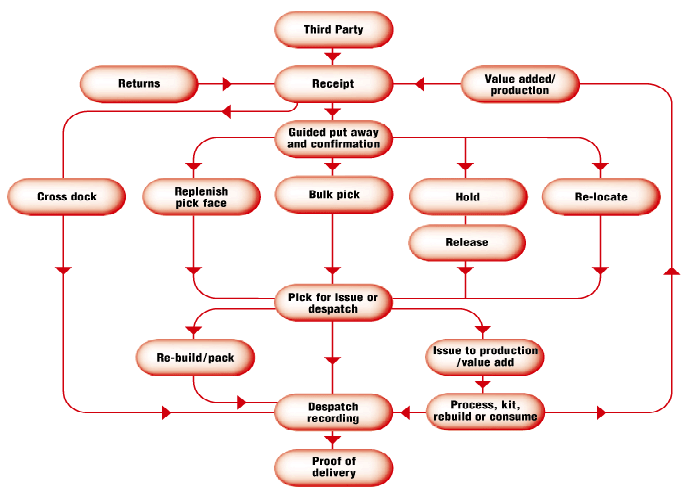
The fundamental purpose of a WMS is to record the real-time location of goods within a warehouse. Typically, WMS manage the inventory of finished goods within an intermediary supply chain facility; raw materials are managed in manufacturing operations by materials requirement planning (MRP) or enterprise resource planning (EPR) strategies. Inventory management systems (IMS) are often a component of WMS, but are not equivalent. WMS distributors or manufacturers typically require a yearly license fee which supports software upgrades.
WMS have grown to accommodate the wide variety of sensors, processors, and automated material handling equipment available. They can significantly reduce or eliminate the need for personnel within warehouses, but require user-defined parameters and support personnel to maintain workflow fluidity. Robotic systems have become prominent. These systems minimize delays, equipment, inaccuracies, and labor to optimize warehouse efficiency.
Since no two warehouses are alike, WMS must be scalable, modular, and configurable to the end user's needs. A WMS can typically support put-away and picking operations achieved by both automated machines and personnel. It calculates the best location for an item to reduce the overall spatial and labor investment of each item.
Receipt and Cataloguing
When a parcel or item arrives at the warehouse from a manufacturer, a barcode, microchip, or RFID tag is affixed so that the WMS data acquisition system can readily identify individual articles with common data acquisition equipment. A manufacturer may have already installed an identification device upon the item as part of another asset management system or to streamline distribution. Machine vision is another means of automated recognition. Many times, the WMS determines at which dock to unload a trailer.
Identification information is relayed to a processor and WMS software which acknowledges receipt of the item, determines the item's point-of-sale destination, and the item's warehouse destination for storage or loading. This data can be held in a physical memory or cloud-based data system. Additional information can be automatically queried, such as parcel weight or quality assurance. The software also manages information such as lot numbers, SKUs, control dates, or any other relevant information.
This information can be relayed to online storefronts and retailers for inventory and overhead accounting.
Storage
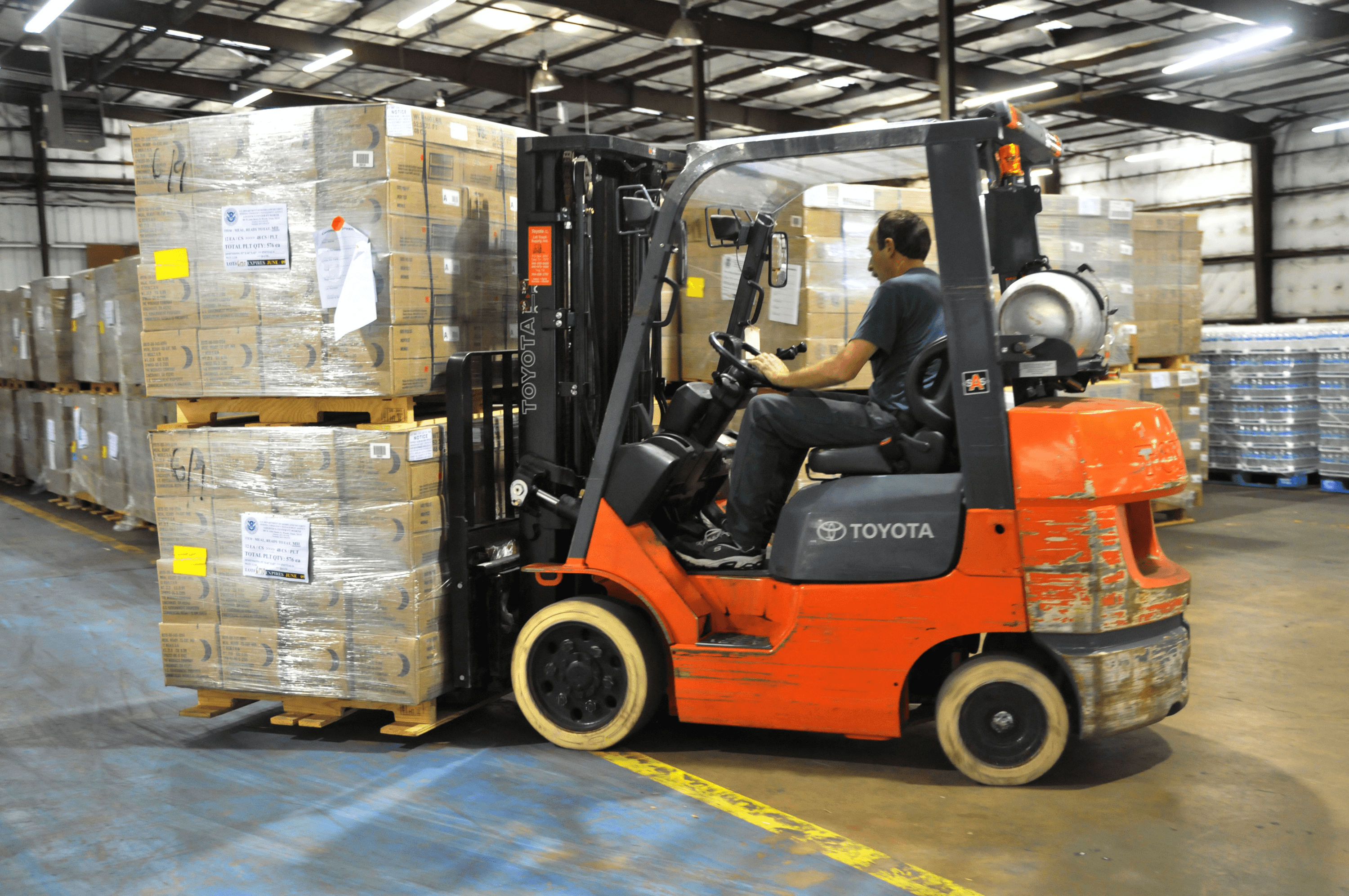 The WMS software determines the optimal location for storage within the warehouse while considering space constraints, shipping destination and date, inventory, and other factors (i.e. products with the same destination or footprint will be stored together). This information is relayed to automated material handling equipment or personnel which will route the items to the determined warehouse location. Items are meant to be easy to find and relocate, and accounts can be referenced to determine inventories.
Order Management and Shipping
Items for shipping are removed from their storage location by material handling equipment and are agglomerated in a staging area for loading into a container or other supply chain vehicle. This process is known as order picking, and WMS support all types of picking practices (order, wave, pick-and-pass, etc.). Items are once again scanned upon their departure to create a departed asset manifest.
Video
Despite an extensive inventory and a network of warehouses, Amazon utilizes a large quantity of manual labor within their WMS framework.
Video credit: CNN Money / CC BY-SA 4.0
Specifications
These values are an effective means of evaluating relative warehouse efficiency, but do not provide a representation of overall warehouse efficiency.
- Lines per hour: how many different items the system can pick, not including multiples of the same item.
- Items per hour: the average number of items a WMS can withdraw from storage for order picking in total, on a per-hour basis.
- Order accuracy: a percentage which indicates how often the WMS fulfills an order correctly.
- Order fill rate: the average value of order expediency.
- Order cycle time: the amount of time between order receipt and when that order has been assembled and is ready for shipping.
- Orders per hour: the average number of orders filled within an hour.
- Cost per order: the average resources expended fulfilling an order.
Other values can provide better performance insight.
- Readiness to deliver: number of requests delivered in due time (#) ÷ number of requests (#)
- Warehouse fill degree: number of occupied locations (#) ÷ total storage capacity per line (#)
- Transshipment level: total turnover ($) ÷ stored value ($)
- Cost/storage location: total cost ($) ÷ storage capacity (#)
- Inventory coverage: stocks ($) ÷ warehouse turnover ($)
- Picking way/item: average picking route(distance) ÷ line count (#)
- Picking density: number of items (#) ÷ gripping space (distance²)
Features
- Batch/lot control: the WMS is suitable for food storage usage, which may require certain lot numbers or expiration dates be stored together.
- Cloud storage: warehouse data is stored by a third-party and can be accessed in the event the WMS malfunctions or on-site data is deleted.
- Cross docking: the WMS can route items right from inbound to outbound, without entering the item into the storage database.
- RFID: items receive an RFID chip which provides identification information in the presence of an RFID reader. It is versatile, non-contact, and does not need line-of-sight to operate.
- Platform: the software is comparable with Windows, Mac, or other operating software.
- Voice-directed picking: software obeys an operator's voice commands.
- Task interleaving: a method of combining item putaway and picking.
- Warehouse linking: the WMS is able to communicate with a WMS at another warehouse location to locate items or fulfill an order.
Resources
Inventory Ops—Warehouse Management Systems (WMS)
Image credits:
Waysa Technology | Wikimedia


