Rock Mechanics In Underground Construction: Proceedings of the ISRM International Symposium 2006 and the 4th Asian Rock Mechanics Symposium

.AYDAN 1 , M.DAIDO 1 , T.ITO 2 , H.TANO 3 and T.KAWAMOTO 4
1 Tokai University, aydan@scc.u-tokai.ac.jp
2 Toyota National College of Technology, tak@toyota-ct.ac.jp
3 Nikon University, tano@civil.ce.nihon-u.ac.jp
4 Nagoya University, Emeritus Professor, choman@poem.ocn.ne.jp
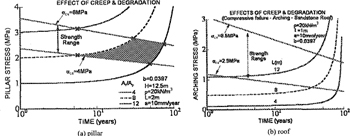
The authors have been involved with some abandoned mines in Tokai Region of Japan and they have been investigating their performance and responses in long term and during earthquakes. In the first part, instability modes of abandoned lignite mines before the ultimate collapse are explained and their instability modes during earthquakes are described. In the next part of the article, Some stability assessment methods for abandoned room & pillar mines are proposed in order to investigate the effects of degradation and creep failure and earthquake loading. It is possible to assess the effects of some fundamental characteristics of the mines such as excavation ratio, overburden ratio etc and to estimate the collapse time of mines in long-term. The theoretical stability analysis method is based on seismic coefficient method for evaluating the stability of abandoned room and pillar mines during earthquakes. These stability analyses results indicated that many abandoned room and pillar lignite mines are prone to collapse in long term as well as during earthquakes, Therefore, some measures against the collapse or subsidence of these abandoned mines are urgently needed.
Keywords: Mine; stability; failure.