|
|
||
|
The Engineering Toolbar
The Ultimate Resource for Engineering and Technical Research. (Learn More) |
|
From Classical Mechanics: An Undergraduate Text

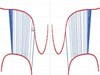
OVERVIEWKEY FEATURES The key features of this chapter are the use of perturbation theory to solve weakly non-linear problems, the notion of phase space, the Poincar Bendixson theorem, and limit cycles. In reality, most oscillating mechanical systems are governed by non-linear equations. The linear oscillation theory developed in Chapter 5 is generally an approximation which is accurate only when the amplitude of the oscillations is small. Unfortunately, non-linear oscillation equations do not have nice exact solutions as their linear counterparts do, and this makes the non-linear theory difficult to investigate analytically. In this chapter we describe two different analytical approaches, each of which is successful in its own way. The first is to use perturbation theory to find successive corrections to the linear theory. This gives a more accurate solution than the linear theory when the non-linear terms in the equation are small. However, because the solution is close to that predicted by the linear theory, new phenomena associated with non-linearity are unlikely to be discovered by perturbation theory! The second approach involves the use of geometrical arguments in phase space. This has the advantage that the non-linear effects can be large, but the conclusions are likely to be qualitative rather than quantitative. A particular triumph of this approach is the Poincar Bendixson theorem, which can be used to prove the existence of limit cycles, a new phenomenon that exists only in the non-linear theory. 8.1 PERIODIC NON-LINEAR OSCILLATIONSMost oscillating mechanical...
Copyright Cambridge University Press 2006 under license agreement with Books24x7
Products & Services
Ultrasonic linear position sensors and switches use ultrasonic waves in combination with light and frequency readings for position and displacement sensing.
Search by Specification |
Learn more about Ultrasonic Linear Position Sensors and Switches
Linear motors generate force only in the direction of travel. They are capable of extremely high speeds, quick acceleration, and accurate positioning.
Search by Specification |
Learn more about Linear Motors
Magnetic speed sensors rely on a magnet as the sensing element or sensed target to capture rotational or linear speed. They are typically used as gear tooth speed sensors or incorporated into stroboscopes or tachometers.
Search by Specification |
Learn more about Magnetic Speed Sensors
Valve actuators mount on valves and, in response to a signal, move a valve to a desired position using an outside power source.
Search by Specification |
Learn more about Valve Actuators
Linear brakes are used to slow or stop linear motion in conveyors, web systems, and vehicles. Technologies include friction, eddy current braking, and hysteresis.
Learn more about Linear Brakes
Product Announcements
Topics of Interest
Chapter List
Chapter Nine: The Energy Principle and Energy Conservation
Chapter Ten: The Linear Momentum Principle and Linear Momentum Conservation
Chapter Eleven: The Angular Momentum...
(Read More)
Chapter List
Chapter 4: Weakly Nonlinear Lateral Sloshing
Chapter 5: Equivalent Mechanical Models
Chapter 6: Parametric Sloshing: Faraday Waves
Chapter 7: Dynamics of Liquid Sloshing...
(Read More)
OVERVIEW
KEY FEATURES
The key features of this chapter are the properties of free undamped oscillations, free damped oscillations, driven oscillations, and coupled oscillations.
Oscillations...
(Read More)
Chapter 1: The Theory of Linear Difference Equations Applied to Population Growth
Review of Complex Numbers
Example
Chapter 2: Nonlinear Difference Equations
Condition for...
(Read More)
Chapter List
Chapter Fifteen: The General Theory of Small Oscillations
Chapter Sixteen: Vector Angular Velocity and Rigid Body Kinematics
Chapter Seventeen: Rotating Reference Frames...
(Read More)
|
|