1.5 The Sewing Approach
An illustrative example of the sewing approach is the analysis of a mooring buoy subjected to a regular forcing from the waves of the ocean [7]. The buoy may be described as an inverted pendulum that, by virtue of buoyancy, maintains an equilibrium state in the upright position. For small excursions, the one-dimensional representation of this system may be cast into the form
| (1.13) |  |
As before, ? denotes the damping coefficient, and B is the forcing amplitude. F(x) represents the restoring force. This force has a contribution h 1 x from the buoyancy. However, if an oil tanker or a large freight ship is moored to the buoy there is also a contribution to F(x) from the forces transmitted through the mooring cable. As the crudest possible approach we may take this force to vanish when the cable is slackened and to contribute an elastic term h 2 x when the cable is stretched. In total this gives a piecewise linear restoring force
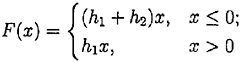
with h 1 and h 2 being constants.
On both sides of the stretching point x=0 the system is linear, and the. equation of motion can be solved analytically. To obtain the global solution we must connect the partial solutions across the sewing surface. For the considered mechanical system, the sewing conditions are that the position x and the velocity  must vary continuously across x=0.
Figure 1.30 shows the results of...
 TABLE OF CONTENTS