

Do Capacitors Really Reduce Noise?
Featured Product from Daitron Co., Ltd.
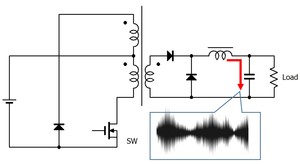
— The Often Overlooked Side Effects —
Adding capacitors is one of the most widely used methods for noise suppression. By shunting differential-mode noise to ground, they can provide effective noise reduction.
However, in practice, factors such as the following can lead to unintended effects:
- Increased ground impedance
- Increased parasitic capacitance
- Changes in current loops
These effects can often result in the conversion of differential-mode noise into common-mode noise.
Furthermore, additional issues such as the following may be introduced:
- Increased radiated emissions due to increased current loop area
- Higher inrush current
- Increased leakage current
- Startup delays
The Essence of Noise Suppression
This behavior is often described as a “whack-a-mole” phenomenon: even if noise is temporarily suppressed, it may reappear in another form.
A More Fundamental Solution: Start with a Low-Noise Power Supply
A more effective approach is to use a power supply designed to minimize noise at its source.
Daitron’s ultra-low-noise switching power supplies offer:
- Ripple noise as low as 1 mVp-p (RFS series)
- Compliance with medical standards (LFS and PFS series)
- Low leakage current design
By reducing reliance on external filtering components, these solutions enable simpler and more reliable noise control.


