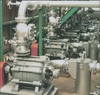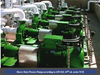
Hermetic TPM Peripheral Pump
Featured Product from Dickow Pump Company, Inc.
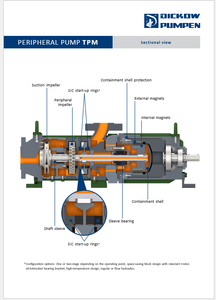
PERIPHERAL PUMP TPM
The magnetic coupled pheriphal pump TPM, also refered to as turbine pump, belongs to the family of centrifugal pumps.
Their structure and operating method is similar to that of a side channel pump. The TPM is able to generate high discharge pressures, even at comparatively low flow rates. It is featured by low NPSH requirements, ideal for applications with limited suction head. Speed-regulated, the TPM can be optimally adjusted to the operating point. Peripheral pumps offer a high tolerance to gas percentages of the fluid, so that continuous operation is even possible in case of gas release or temporary air inlet. To prevent the impellers from seizing under difficult operating conditions, these Dickow pumps are equipped with SiC start-up rings on both sides. Metal contact between the rotating and stationary components is therefore excluded. The hermetically sealed design makes it particularly suitable for pumping toxic, explosive and generally environmentally harmful fluids. The hermetically sealed design makes it particularly suitable for pumping toxic, explosive and generally environmentally harmful fluids.
Applications
- Oil & Gas
- Chemistry & Petrochemistry
- Offshore
- Ship technology & Marine
- Refueling equipment & Aviation
- Tank storage & Tank farms
- Renewable energy & Environmental engineering
YOUR BENEFIT:
- Low capacity/minimum flow possible versus high heads
- Sturdy, low-wear, hermetically sealed
- Low noise emission
- High gas percentage pumpable/NPSHr efficient design
- Pulsation-free output
Why Sealless?
Why Use Dickow Magnet Drive Pumps?
Since the 1970s concern for the environment has become increasingly important in the design of industrial plants. Today this issue is a vital concern in any discussion involving new plants and updating of facilities. Equipment designers, engineers, and suppliers must offer solutions which will eliminate any adverse environmental impact, or at a minimum reduce it to sustainable or regulated levels.
The weakest link with respect to centrifugal pumps is the shaft seal, when considering release of fluids to the environment. This is because there is always some inherent emissions from mechanical seals. The average emission rate of a mechanical seal is 0.13 GPM to 0.35 GPM, and although this appears to be quite small, the actual atmospheric penetration is quite large when one considers that large chemical plants have thousands of pumps in operation. In 1989 the Environmental Protection Agency (EPA) published its first report on environmental pollution. The report documents that American chemical and petrochemical industries, in 1987, emitted 390 tons of toxic materials into the atmosphere, in part attributable to pump leakage.
Potential problems occur by the formation of dangerous explosive mixtures, which become worse when toxic or malodorous gasses and vapors endanger plant personnel. In order to prevent the vaporization of liquids between seal faces additional cooling is required when the media has vapor pressure greater than atmospheric pressure at operating temperatures. Additionally, when handling fluids that crystallize in the atmosphere, an appropriate quench connection or barrier fluid must be provided.
Various attempts have been made to improve the performance of mechanical seals in order to meet regulations pertaining to emissions. Examples include double acting mechanical seals of "tandem design", "back-to-back design", and various gas seal types. All of these require auxiliary equipment, systems, and controls. For many applications the costs of this equipment is not justifiable in light of the gains attained.
It would appear that the outer limits have been reached for improvements in mechanical seals with regard to reliability and emissions control. The only realistic solution is a sealless pump with zero leakage, i.e. without the connection of the media to the environment due to the absence of a seal. Many of our earliest customers installed Dickow sealless magnet drive pumps for their zero leakage feature, but quickly realized that their mean times between failures was greatly improved as down time due to seal replacement was eliminated completely.
Click Here for our MAG-Safe Temperature Monitoring System
Dickow Pump Company has produced pumps for over 100 years. Our pumps are working steadily and dependably in all corners of the globe.
As the technical world leader in magnetic drive pumps, Dickow holds many patents, is ISO 9001 certified, and is a supplier-partner of major chemical companies.