Integrate Modular Conveyors with Existing Machines
Featured Product from Dorner Manufacturing Corp.
The Integration Challenge in Modern Manufacturing
Adding conveyors to an existing production line shouldn’t mean shutting everything down for weeks. But with traditional systems, that’s often exactly what happens. Custom engineering drags on, fabrication takes forever, and every hour of downtime hits the bottom line.
Modular conveyors take a different approach. Standardized, pre-engineered components bolt directly into your current setup, cutting installation time dramatically. For automation integrators building new cells or plant engineers upgrading legacy equipment, it’s a way to get capacity online faster without ripping everything out and starting over.
What Are Modular Conveyors and How Do They Simplify Integration?
Modular conveyors are precision-engineered material handling systems built from standardized, interchangeable components that can be quickly assembled, reconfigured, and connected to existing production equipment. Unlike custom-fabricated conveyor systems that require extensive lead times and specialized installation, modular designs use universal mounting points, industry-standard pallet sizes, and plug-and-play control interfaces.
The key benefits of modular conveyor integration include:
- Reduced installation time: Pre-engineered sub-assemblies ship ready for fast installation, with many systems operational within days rather than weeks.
- Lower integration costs: Standardized components eliminate expensive custom fabrication and reduce engineering hours.
- Future-proof flexibility: Reconfigure layouts as production needs change without replacing entire conveyor runs.
- Seamless machinery connection: Universal T-slots, precision mounting points, and compatible control systems connect directly to existing equipment.
- Minimal production disruption: Modular components can be staged and pre-assembled off-line, minimizing costly downtime during installation.
Common Integration Challenges Modular Conveyors Solve
Automation integrators and manufacturing engineers frequently encounter obstacles when connecting conveyors to existing production equipment. Understanding these pain points reveals why modular designs have become the preferred solution for modern integration projects.
Space Constraints and Layout Limitations
Production floors rarely offer ideal conditions for conveyor installation. Existing machinery, support columns, utility runs, and traffic patterns create complex obstacles. Traditional conveyor systems often require extensive custom engineering to navigate these constraints, adding weeks to project timelines and significant cost overruns.
Modular flexible chain conveyors, like the Dorner FlexMove platform, address this challenge directly. With the industry’s most flexible plastic chain belt technology, these systems navigate tight turns, inclines, and declines in a single continuous run. Low-profile frame designs fit into spaces where conventional conveyors cannot operate, enabling integration in the most challenging facility layouts.
Connecting to Diverse Equipment Types
Modern production environments often include equipment from multiple vendors, each with different mounting standards, control protocols, and timing requirements. This equipment diversity creates significant integration complexity.
Modular conveyors solve this through standardized interfaces:
- Universal T-slots built into conveyor frames allow quick attachment of guide rails, sensors, and mounting brackets at any point along the length of the conveyor.
- Industry-compatible pallet sizes in pallet conveyor systems ensure smooth product handoffs between different manufacturers’ equipment.
- Control solutions integrate with multiple PLC platforms, including Allen-Bradley, Siemens, and Keyence, using standard protocols like Ethernet/IP and IO-Link.
Meeting Precision Positioning Requirements
Automated assembly, robotic pick-and-place operations, and vision inspection systems demand precise product positioning—often within fractions of a millimeter. Achieving this accuracy while integrating with existing machinery requires conveyors specifically designed for precision applications.
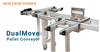
The DualMove Pallet System addresses this need with timing belt-driven technology that achieves positioning accuracy within ±0.5mm. Precision Move conveyors in the 2200 and 3200 Series offer mechanical accuracy of ±0.02″ with servo motor index repeatability of ±0.04″, enabling seamless integration with high-precision automation equipment.
Key Advantages of Configurable Modular DesignsStandardized Components for Faster Assembly
The foundation of simplified integration lies in standardization. When conveyor components follow consistent design standards, integration becomes predictable and repeatable. Rather than engineering each connection point from scratch, integrators select from proven component libraries that include pre-engineered curves, inclines, merges, and transfer modules.
Dorner’s modular conveyor platforms demonstrate this principle. Dorner’s low-profile, aluminum frame conveyors feature a single-piece frame design with universal T-slots that accept industry-standard hardware. This eliminates custom bracket fabrication and allows accessories like photo-eyes, sensors, and product guides to mount in minutes rather than hours.
Every conveyor series also features a range of transfer tail options, from nose bar rollers for small parts transfers to powered rollers for unstable or heavy products. Matching transfer points to the needs of a production line ensures seamless product transport, positioning accuracy, and reduced product damage from misalignment or toppling.
Reconfigurable Layouts for Evolving Production Needs
Production requirements change. New products launch, volumes fluctuate, and processes evolve. Traditional conveyor systems become stranded assets when layouts need modification—expensive to remove and difficult to reconfigure for new production requirements.
Modular conveyors with customizable zoning capabilities transform this equation. Pallet conveyors such as Dorner’s ERT series and DualMove series offer in-the-field customizability for production zones, allowing for pallet accumulation and redirection based on fluctuating production line needs. The cross-compatible design of these systems also simplifies expanding or reconfiguring the line layout to create new work zones for different processes or increased volume requirements.
Plug-and-Play Control Integration
Control system integration often represents the most complex aspect of connecting new conveyors to existing machinery. Different equipment uses different communication protocols, safety circuits, and programming languages. Without careful planning, control integration can consume more time and budget than the mechanical installation.
Dorner’s Controls Solutions, powered by Magnetek, address this challenge with UL508A-certified control systems designed for seamless integration. These systems support standard machine communication protocols including Ethernet/IP and IO-Link, with compatibility across major PLC platforms. The turnkey approach shifts control integration burden from the customer’s engineering team to experienced specialists, accelerating project timelines and reducing technical risk.
Modular Conveyor Solutions for Integration Applications
Different integration scenarios require different conveyor capabilities. Understanding which modular platform fits specific application requirements ensures successful integration outcomes.