Telemecanique XS118BLNAL2 Inductive Sensor
Featured Product from ERSAELECTRONICS PTE. LTD.
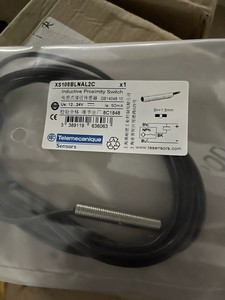
The Telemecanique Sensors XS118BLNAL2 is a general-purpose inductive proximity sensor designed for reliable, non-contact detection of metallic objects in industrial automation systems. It belongs to the Telemecanique Inductive Proximity Sensors XS range and combines an M18 threaded cylindrical body, flush-mountable sensing face, nickel-plated brass enclosure, and protected three-wire DC output.
The sensor offers a nominal sensing distance of 5 mm and a specified operating zone of 0 to 4 mm. When a suitable metallic target enters this operating zone, the XS118BLNAL2 activates its NPN normally open output. This discrete switching signal can be connected to a PLC input, industrial controller, relay interface, or other compatible control circuit.
Because the sensor detects metal through an electromagnetic field, it does not need to physically touch the target. This eliminates the mechanical contact wear, impact, and contact bounce associated with traditional limit switches. The XS118BLNAL2 is therefore suitable for high-cycle position detection, component counting, machine sequencing, and metal-part verification.
It is important to note that the XS118BLNAL2 is an on/off proximity sensor rather than a measuring sensor. It does not provide a proportional analog output indicating the exact distance between the sensor and the target.
Key Specifications
| Parameter | XS118BLNAL2 Specification |
|---|---|
| Manufacturer | Telemecanique Sensors |
| Product range | Inductive Proximity Sensors XS |
| Sensor series | XS1, general purpose |
| Sensing technology | Inductive |
| Body style | Cylindrical M18 |
| Thread size | M18 × 1 |
| Body length | 53 mm |
| Threaded length | 41 mm |
| Mounting method | Flush mountable |
| Nominal sensing distance | 5 mm |
| Specified operating zone | 0–4 mm |
| Output configuration | NPN, normally open |
| Wiring system | Three-wire DC |
| Rated supply voltage | 12–24 VDC |
| Supply-voltage limits | 10–36 VDC |
| Maximum switching current | 200 mA |
| Maximum switching frequency | 1,200 Hz |
| Connection method | Pre-wired 2 m cable |
| Cable construction | 3 × 0.14 mm² PVC cable |
| Output indication | Yellow LED |
| Protection rating | IP67 |
| Enclosure material | Nickel-plated brass |
| Sensing-face material | PBT |
| Operating temperature | –25°C to +70°C |
| Storage temperature | –40°C to +85°C |
| Net weight | Approximately 0.105 kg |
| Certifications | UL, CSA and CE marking |
Inductive Metal Detection
The XS118BLNAL2 generates a high-frequency electromagnetic field in front of its active sensing face. When a conductive metal target enters this field, eddy currents form within the target and absorb energy from the sensor’s oscillator. The internal electronics detect this change and switch the output transistor.
This sensing method allows the sensor to identify metallic objects without direct physical contact. It is particularly useful in industrial environments where a mechanical switch could be damaged by repeated impacts, contamination, misalignment, or continuous operation.
The published 5 mm value is the nominal sensing distance measured under standardized conditions with a defined steel target. For practical equipment design, the specified operating zone of 0 to 4 mm should be used. Installing the target comfortably inside this range provides better switching stability than operating continuously at the maximum nominal distance.
Actual detection performance can be affected by the target’s material, dimensions, thickness, orientation, and approach direction. Standard steel normally produces the strongest response. Stainless steel, aluminum, copper, and brass may have lower correction factors and therefore require a shorter distance between the target and the sensing face.
Flush-Mountable M18 Housing
The sensor uses an M18 × 1 threaded cylindrical housing with a frontal sensing face. Its flush-mountable design allows the body to be installed inside a metal bracket or machine surface while the sensing face remains appropriately positioned toward the target.
Flush mounting helps protect the sensor against accidental side impacts and creates a more controlled sensing field. However, the manufacturer’s installation clearances should still be followed to avoid interference from nearby metal or adjacent sensors.
The 53 mm body includes a 41 mm threaded section, allowing the sensing position to be adjusted through a mounting bracket or machine panel. The nickel-plated brass enclosure provides mechanical strength, while the PBT front face forms the active sensing surface.
The sensor should be secured with suitable M18 mounting nuts and tightened within the recommended torque limit. It should not be used as a mechanical end stop, and moving equipment should not be allowed to strike the sensing face.
NPN Normally Open Output
The XS118BLNAL2 has a three-wire NPN normally open output. When no target is detected, the output transistor remains off. When a suitable metallic object enters the sensing zone, the transistor switches on and sinks current toward the 0 V supply connection.
The standard wiring arrangement is:
- Brown wire: positive DC supply
- Blue wire: 0 V or negative supply
- Black wire: switched NPN output
The connected PLC input or control circuit must be compatible with an NPN sinking output. The load is typically connected between the positive supply and the black output conductor. An NPN sensor should not be substituted directly for a PNP sensor without checking the input architecture and wiring of the control system.
The sensor has a rated supply voltage of 12–24 VDC and can operate within limits of 10–36 VDC. Its output supports a switching current of up to 200 mA and includes reverse-polarity, overload, and short-circuit protection. The closed-state voltage drop is less than 2 V, while no-load current consumption is no more than 10 mA.
Although the output can handle up to 200 mA, it is intended primarily for control signals. Large solenoids, motors, lamps, and other high-current loads should be controlled through an appropriate relay, interface module, or protected driver circuit.
When integrating the sensor into a custom controller, designers should consider input protection, grounding, connector selection, noise immunity, and power-supply filtering. MOZPCB provides PCB fabrication services for industrial control and sensor electronics, supporting projects from prototype validation through volume production.
Response and Switching Performance
With a maximum switching frequency of 1,200 Hz, the XS118BLNAL2 can detect relatively fast-moving targets when their size, spacing, and exposure time are suitable. The stated first-power-up delay is up to 15 ms, with a response delay of approximately 0.1 ms and a recovery delay of approximately 0.3 ms.
These response characteristics make the sensor suitable for component counting, rotating cam detection, machine-cycle monitoring, conveyor sequencing, and production-line position feedback. However, total system response also depends on target geometry, target speed, PLC scan time, input filtering, and the control program.
A yellow LED indicates the output state. This local indication helps technicians confirm sensor operation during mounting, alignment, commissioning, and troubleshooting.
Environmental and Mechanical Performance
The XS118BLNAL2 carries an IP67 protection rating when correctly installed. It is protected against dust ingress and temporary water immersion under the test conditions defined by IEC 60529. IP67 does not indicate suitability for continuous underwater operation, high-pressure washdown, or unrestricted exposure to industrial chemicals.
The operating temperature range is –25°C to +70°C, while the storage range is –40°C to +85°C. Where specifications use Fahrenheit or Kelvin, these values can be checked with the ResiCalc Celsius-to-Fahrenheit temperature converter.
The sensor is also designed to withstand industrial vibration and mechanical shock. Published ratings include vibration resistance up to 25 gn over 10–55 Hz and shock resistance up to 50 gn for 11 ms under the referenced IEC test conditions.
Proper mounting remains important. The cable should be secured so that movement or vibration is not transferred directly to the cable entry, and the sensing face should be protected from severe impact.
Typical Applications
The XS118BLNAL2 can be used in applications such as:
- Metal-part presence detection
- Conveyor product counting
- Machine-slide position confirmation
- Gear, cam, and shaft monitoring
- Packaging-machine sequencing
- Assembly-line component verification
- Robotic end-position detection
- Tool and fixture position monitoring
- Material-handling equipment
- Elevator and escalator systems
- Automated production machinery
- Metal door and guard position detection
Inductive sensing is specifically intended for metallic targets. Applications involving plastic, paper, glass, wood, liquids, or other non-metallic materials may require a capacitive, photoelectric, or ultrasonic sensor. The MOZ Electronics proximity sensor selection guide explains the main differences between these technologies and their appropriate applications.
Installation and Selection Considerations
Before ordering the XS118BLNAL2, verify the output polarity, switching function, target material, mounting arrangement, cable length, supply voltage, and environmental requirements. Similar XS1 models may use PNP instead of NPN output, normally closed instead of normally open switching, a connector instead of a cable, or a different sensing distance.
The target should pass comfortably within the specified 0–4 mm operating zone. A mechanism that positions the target only at the extreme edge of the sensing range may produce unstable operation as temperature, vibration, alignment, or target material changes.
The 2 m PVC cable should be routed away from sharp edges, moving machine components, high-current power cables, contactors, variable-frequency drives, and other sources of electrical interference. Sensor wiring should follow the manufacturer’s diagram, and the output must be connected to a compatible sinking-input circuit.
For maintenance or production purchases, buyers should confirm the full part number, manufacturer identity, packaging condition, traceability, date code, stock location, and required delivery schedule. Availability and sourcing requirements can be reviewed through the Octatronics Sensors.
Summary
The Telemecanique Sensors XS118BLNAL2 is a durable M18 inductive proximity sensor for non-contact metallic-object detection. Its 5 mm nominal sensing distance, 0–4 mm operating zone, NPN normally open output, 12–24 VDC rated supply, 200 mA switching capacity, and 1,200 Hz maximum switching frequency make it suitable for a wide range of industrial automation applications.
With its flush-mountable nickel-plated brass housing, pre-wired 2 m cable, yellow output LED, IP67 protection, and integrated electrical protection, the XS118BLNAL2 provides a practical solution for metal-part detection, position confirmation, equipment sequencing, and component-counting systems.