Shunt-Based Technologies for eFuses
Featured Product from Isabellenhutte USA

The Challenge in the Modern Automotive Industry: Electronic Components and Innovative Fuse Solutions in Vehicles
The modern automotive industry faces the challenge of keeping pace with the increasing complexity and variety of electronic components in vehicles. While innovations such as autonomous driving systems and electric drivetrains enhance vehicle efficiency and safety, they also introduce significant technical and safety-related requirements.
Here we highlight the evolution and impact of automotive electronics, problems associated with traditional fuse systems, and advancements in integrating electronic disconnect switches to meet escalating demands.
Increasing Electronics Complexity in Vehicles
The number of electronic components in modern vehicles has continuously grown over recent years. This development is mainly driven by advanced driver assistance systems (ADAS) and electrification of the drivetrain. These systems not only improve vehicle efficiency and safety but also require increasingly complex electronic architectures. However, with this rise in electronic complexity comes increased susceptibility to system failures, posing additional challenges to functional safety.
Safety-critical systems such as electronic steering or braking systems are essential for driving safety and must operate with absolute reliability. Yet, they often share the 12V electrical system with fewer safety-critical components, like infotainment systems. This connectivity poses the risk that a malfunction in a non-critical system might adversely affect safety-critical components, potentially resulting in total vehicle control failure.
To mitigate this risk and ensure functional safety, vehicles are equipped with specialized fuses designed to isolate affected systems from the onboard electrical network in case of faults, preventing errors from impacting safetycritical components. Consequently, vehicle safety is maintained even if parts of the electronics fail.
Requirements for fuse systems have increased substantially in recent years, due to the growing complexity and number of electronic components in vehicles. Additionally, they must comply with the stringent requirements of ISO 26262 for safety-critical systems, demanding precise and reliable functionality in critical situations. Thus, modern automotive technologies require not only increasingly powerful electronics but also continuous advancement in safety mechanisms to ensure reliability and road safety.
Challenges of Traditional Melt Fuses
With the rise in electronic components, the demands on safety technology have also grown. Fuses, which disconnect the affected system from the electrical network during faults, play a central
role in automotive electrical systems. Currently, many automotive applications still rely primarily on melt fuses, which are increasingly reaching their limits.
Melt fuses are simple in operation but present several challenges. A key issue is their limited flexibility; available only in fixed values, they hinder developers from implementing individually optimized protection for specific circuits. Consequently, designs must adapt to predefined fuse values, often leading to suboptimal solutions. Moreover, melt fuses have insufficient accuracy and sluggish response times, lacking early warnings in overload situations, further affecting reaction times and safety. Additionally, melt fuses are destroyed upon failure, potentially leaving vehicles inoperable and requiring towing.
Integration of Power Distribution Units
Parallel to the challenges posed by melt fuses, the number of electronic components in vehicles continues to grow. Systems such as radar, lidar, and camera sensors require increasingly sophisticated power distribution and protection. Due to rising complexity in electronic architectures, manufacturers are increasingly adopting modern solutions to enhance flexibility and efficiency. One such approach involves using power distribution units (PDUs), replacing traditional central fuse boxes.
PDUs offer modular, adaptable solutions tailored to modern vehicle requirements. They are often integrated into future zone controllers, each protecting a specific vehicle region (e.g. front left/right, rear left/ right). A significant advantage of PDUs is shifting protection to these zonal controllers, which manage power distribution and communicate with the central vehicle controller. This architecture, known as zone or domain controllers, significantly enhances flexibility, accuracy, and response speed to potential faults, greatly improving overall vehicle safety and efficiency.
The integration of this modern technology not only optimizes the protection of vehicle components optimized, but also the complexity of the electronics better managed, which is essential in an increasingly networked and technologically advanced vehicle world.
Traditional melt fuses are replaced by electronic fuses, known as electronic disconnect switches (eFuses). These semiconductor circuits measure current flow in real time and selectively disconnect affected components during overloads. Their flexibility allows multiple components to be combined into a single system, enabling more efficient management and protection of the vehicle’s electrical network.
An illustrative example of an electronically controlled PDU is Bosch’s Powernet Guardian concept. This solution separates safety-critical applications from non-critical applications, ensuring that safety- related functions remain operational even in case of an electrical fault. Consequently, the vehicle can still be safely controlled. Furthermore, safety-critical components meet requirements up to ASIL D according to ISO 26262.
Shunt-Based Technologies for eFuses
A critical aspect of these electronic fuses is precise current measurement, typically achieved using shuntbased technology. Isabellenhütte offers a comprehensive portfolio of suitable components ideal for eFuse applications. Particularly noteworthy is the BV series of electron beam-welded shunts, featuring high pulse, continuous load capability, and low resistance from 100 μΩ, covering a wide application spectrum.
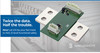
One specific example is the BVE 2 terminal resistor with a resistance value of 100 μΩ. This component withstands pulse loads of up to 60 W for a pulse duration of 0.2 seconds, equating to approximately 775 A at a contact temperature of 70°C. Even higher pulse loads are possible at lower temperatures. These characteristics make the BVE particularly suitable for 12V electric vehicle applications.
Additionally, Isabellenhütte continuously develops new resistance values below 100 μΩ using SMD technology, enabling even more precise and application-optimized protection for electronic fuses. These shunt resistors significantly contribute to the advancement of modern power distribution units and safe, efficient power distribution in future vehicle generations.
The components BVE, BVS, and BVT offer resistance values from 0.1 to 0.3 mΩ, meeting specific application requirements. If necessary, Isabellenhütte can also evaluate components with even lower resistance values to avoid parallel connections and efficiently utilize installation space.
FAQs
What are the key challenges of modern automotive electronics?
The increasing complexity of vehicle electronics, driven by advancements such as ADAS (Advanced Driver Assistance Systems) and electric drivetrains, creates numerous challenges. These include ensuring system reliability, meeting stringent safety standards like ISO 26262, and managing potential failures in safety-critical systems.
Why are traditional melt fuses becoming less effective in modern vehicles?
Traditional melt fuses lack flexibility, have slow response times, and are destroyed upon failure. They cannot meet the growing complexity and safety requirements of modern vehicles, nor can they provide precise and efficient circuit protection.
How do zone controllers enhance vehicle safety and performance?
Zone controllers manage and protect specific areas of a vehicle (e.g., front left/right or rear left/right). They improve power distribution, accuracy, and response times to faults. This enhancement ensures safety-critical systems are isolated from non-critical applications during electrical failures.
What is shunt-based technology, and why is it important for eFuses?
Shunt-based technology uses precision resistors to measure current flow, enabling eFuses to detect overloads accurately and disconnect affected components. This technology ensures precise protection for electronic circuits, especially in high-demand applications.
What role does ISO 26262 play in automotive electronics?
ISO 26262 is a functional safety standard for automotive systems, ensuring that safety-critical systems operate reliably even under fault conditions. Complying with ISO 26262 is essential for ensuring both the safety and functionality of modern vehicle electronics.
How do eFuses support compliance with safety standards like ISO 26262?
eFuses offer precise current monitoring and fast response times, significantly improving reliability in vehicle safety-critical systems. They meet ASIL D (Automotive Safety Integrity Level D) requirements, ensuring the highest level of safety performance.
What are the resistance ranges of components like BVE, BVS, and BVT for eFuses?
The BVE, BVS, and BVT components offer resistance values ranging from 0.1 to 0.3 mΩ. For more precise or application-specific requirements, even lower resistance values can be evaluated.
Isabellenhütte USA
Isabellenhütte USA is headquartered in Swansea, Massachusetts and has developed an industry-wide reputation for providing high quality products and unparalleled customer support. We are known world-wide in industries ranging from aerospace and medical to energy and automotive.
We believe that imagination and innovation are the fuel for forward progress. We are intensely focused on our customers and their challenges—always looking for new possibilities and ways to help them win.
The crucial factor for our success as a technology leader is the concentration of a wide range of production steps and proprietary technologies in-house. Our vertically integrated value chain—and the continuous improvement of processes—are the basis of our outstanding technical and innovative capability.