Directional Coupler Primer
Featured Product from KRYTAR, Inc.
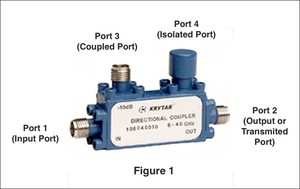
Directional Couplers are passive devices used for sampling incident and reflected microwave power, conveniently and accurately, with minimal disturbance to the transmission line. Directional couplers are used in many different testing applications where power or frequency needs to be monitored, leveled, alarmed or controlled. These include providing a signal sample for measurement or monitoring, feedback, combining feeds to and from antennas, antenna beam forming, providing taps for cable distributed systems such as cable TV, separating transmitted and received signals on telephone lines, in addition to electronic warfare (EW) systems and the emerging mmWave and 5G wireless communications systems. As coaxial systems reach higher frequencies, it becomes critical to sample and level signals over broad instantaneous bandwidths.
For many RF, microwave and mmWave systems, a constant monitoring of frequency is necessary from the output of microwave transmitters, systems or special test setups. A directional coupler is connected to the output of the system or instrument. A small amount of power and frequency is coupled from the main line and connected to a frequency meter. This provides a constant measurement of frequency. Power output from microwave transmitters may degrade as a function of time. A directional coupler may be used to couple a small amount of power from the main line. The power from the coupled port is then connected to a Power Meter where power can be constantly monitored. The power from the coupled port could be connected to a detector. The DC output voltage from the detector could be used in a feedback circuit to assure power output is constant – or – the voltage could be used to trigger shut down of the transmitter if the power is either too high or too low. The voltage could also be used to sound an alarm or trigger a data recorder as long as the power was out of its operating window. If the transmitter is located in a remote location, the voltage could cause an alert to be made to a technician that the transmitter is not performing to specifications.
Check out this "Primer" to learn more. A PDF version is also available.