Ultimate Guide to Power Feedthroughs
Featured Product from MPF Products, INC.

Introduction
In 1905, Albert Einstein wrote what has been described as “the most revolutionary sentence written by a physicist of the 20th century.”
According to the assumption to be contemplated here, when a light ray is spreading from a point, the energy is not distributed continuously over ever-increasing spaces, but consists of a finite number of energy quanta that are localized in points in space, move without dividing, and can be absorbed or generated only as a whole.
This sentence essentially laid out the idea of photons, and the idea that light does not travel in a wave but rather as individual particles. From there, he theorized that metal absorbs light and that once the metal had reached capacity, it would begin releasing photons.
For some decades before, and many decades after, physicists had been exploring the possibility of harnessing the sun’s energy to create electricity. In 1954 scientists at Bell Labs discovered – partially by accident – that when impurities were added to silicon, and it was exposed to light, it would emit a strong electric current.
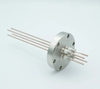
Throughout decades of discovering how to utilize and convert electricity, it was also important to figure out how to harness and properly contain it. Feedthroughs ensure that electricity is properly contained and distributed so that there are not voltage leaks throughout a machine.
Quick Links: