Flow Meter Squeezes Into Tight Retrofit Projects
Featured Product from McCrometer, Inc.
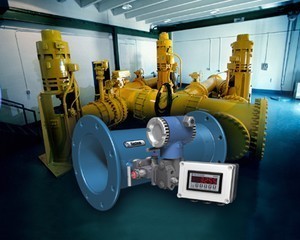
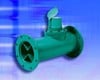
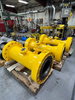
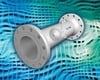
With its innovative design, the V-Cone Flow Meter from McCrometer offers superior accuracy and can be installed in close proximity to pumps in crowded plant retrofit projects by reducing up to 70 percent the straight-pipe runs required by other meters, which results in real estate, pipe and labor cost savings that can actually exceed the cost of the instrument.
The precision V-Cone Flow Meter operates over a wide flow range of 10:1 with low head loss and supports line sizes from 4 to greater than 18 inches. Accuracy is +1% over a 40 to 7500 gallon per minute liquid flow rate, depending on the line size. Industrial plant water and wastewater engineers can rely on the V-Cone for consistent performance and low cost of ownership because it requires virtually no recalibration or maintenance over an exceptionally long life.
The space-saving V-Cone Flow Meter reduces flow meter straight pipe run requirements by up to 70 percent or more and needs only 0-3 straight pipe diameters upstream and 0-1 downstream to operate effectively. It is especially useful in plant water intake systems, cooling water lines, wastewater effluent treatment lines, filter galleries and recycled water management.
The V-Cone's unique no-moving parts design provides built-in flow conditioning, which almost eliminates the upstream/downstream straight pipe runs required by nearly all flow meter technologies. Typical flow meter installations may require 10 to more than 40 straight pipe diameters upstream from the meter and 5 or more straight pipe diameters downstream to eliminate the effects of swirl and other pipeline disturbances caused by pumps, elbows, valves and other devices that negatively affect measurement accuracy.
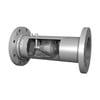
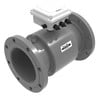
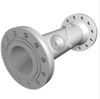
In comparison to traditional instruments such as magnetic and venturi flow meters, the V-Cone's design is inherently more accurate because the flow conditioning function is built-into the basic instrument. The V-Cone conditions fluid flow to provide a stable flow profile that increases accuracy. It features a centrally-located cone inside a tube. The cone interacts with the fluid flow and reshapes the velocity profile to create a lower pressure region immediately downstream.
The pressure difference, which is exhibited between the static line pressure and the low pressure created downstream of the cone, can be measured via two pressure sensing taps. One tap is placed slightly upstream of the cone and the other is located in the downstream face of the cone itself. The pressure difference can then be incorporated into a derivation of the Bernoulli equation to determine the volumetric fluid flow rate.