DIP Switches Guides: Types, Applications & Buying
Featured Product from ODG (Origin Data Global)
Introduction
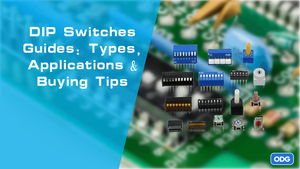
A DIP switch, Dual In-line Package switch, is a small switch placed in a common dual in line package. As a result, the design places the switches packaged in a small, rectangular holder with two rows of pins next to each other. They provide a simple way to enter data in binary form.
DIP switches began to appear in the late sixties and became a common component through the seventies. Engineers designed these connectors to serve as a useful option instead of soldered or jumped hardware.
They provide flexibility for setting up hardware. In the years that followed, consumer electronics and computing advanced. As a result, DIP switches appeared in many devices.
Many experts still find them useful. This is true even with the growth of software configuration. They are important in areas where being separate from updates, simple, and reliable matters.
In many industries, including automotive and consumer areas, they are a cheap way to manage hardware options. This is mainly because field technicians can make changes quickly.
How DIP Switches Work
DIP switches may seem simple, but to understand them, we must look at their design and electrical function. Their small build still provides dependable results across many uses. We’ll begin by examining the components that make up corporations inside.
1. Mechanical Operation and Internal Structure
DIP switches work by opening or closing an electrical connection. This makes them easy to set a different radio frequency. In contrast, electronic or sensor switches need software or firmware to work.
Each DIP switch contains small metal contacts, a spring and an actuator which is most often a slider, rocker or dial. By placing the actuator in the ON position, electrical current is able to flow because the contacts move together. The OFF position interrupts the connections between the contacts. Because of this simple structure, they typically remain reliable and do not change much over the years.
The application determines how equipment actuates. Users most often use slider switches to change a state by sliding left or right. Rocker switches resemble small light switches that clearly indicate when you turn them on. To set the pc expansion cards, turn the Rotary DIP switches to one of the available positions.
2. Electrical Characteristics and Actuation Methods
Individual switches are meant for uses where the voltage and current are low. The DC batteries we use usually provide 12V to 24V of voltage and currents range from 10mA to 100mA. Because of their specific properties, these circuits suit logic circuits, embedded systems and consumer products well. However, they are not suitable for large power switching.
All actuation methods have special contributions to make. Slider switches occupy little space and are simple to operate in confined areas. The clear click some rocker switches produce gives users a simple and clear signal. Using rotary switches works well when you need to access several different configurations.
They are simple and reliable. They do not link to digital technology. This is why you often find them in industrial control panels, development boards, and older electronics.
Types of DIP Switches
Combo, Combi, Combined, and Dual In-line Package switches come in different types. They match various software and hardware needs. You need to know the distinctions between these types to pick the right one for your work. After this, we explain the most typical varieties of DIP switches by giving examples for every type.
1. Standard Slide DIP Switches
This kinds of switch type usually standard. People regularly use them to set PCB configurations, for example, device addresses or selections of features.
| Part Number | Manufacturer | Key Features | Applications |
| 219-4LPST | CTS | 4-position, SPST, 0.1A @ 20VDC, surface mount, epoxy sealed | General-purpose PCB configurations |
| CHS-01TA | Nidec Components | 1-position, SPST, 6V, 100mA, surface mount | Consumer electronics, small devices |
| DS01C-254-L-08BE | Same Sky | 8-position, SPST, 0.025A @ 24VDC, through-hole | Industrial control panels |
| MCDHA-08TQR | Multicomp Pro | 8-position, SPST, 25mA @ 24VDC, low-profile, surface mount | Automation and process control |
| SD08H1SBD | C&K Components | 8-position, SPST, 100mA @ 25VDC, low-profile, surface mount | Logic switching in computers and peripherals |
2. Rotary DIP Switch (Encoded vs. Non-Encoded)
To change the settings with Rotary DIP switch, just spin a dial to the correct position. Two types exist that people use during the holiday season.
Positioned correctly, rotary switches output binary numbers that are convenient for setting a device’s addresses.
A simple rotary switch connects directly to a chosen output. The lack of encoding makes it better for easy selection tasks.
People typically use communication equipment, industrial controllers, and embedded systems in places where different configurations are necessary.
| Part Number | Manufacturer | Key Features | Applications |
| CRD Series | C&K Components | 10mm coded rotary, 4-16 positions, SPST, washable | Address setting in communication equipment |
| CD Series | C&K Components | 8mm coded rotary, 8-16 positions, SPST, washable | Mode selection in embedded systems |
| RTF Series | C&K Components | Low-profile rotary, 7.2mm x 7.2mm, SPST, washable | Compact industrial controllers |
| RT Series | C&K Components | Low-profile rotary, 10 positions, SPST, washable | Networking devices, routers |
| RTE Series | C&K Components | Low-profile rotary, 10 positions, SPST, washable | Test and measurement equipment |
3. Piano DIP Switches
Vertically oriented actuators on DIP switch shaped like piano keys exist. These designs suit crowded situations where room is not plentiful, so you can press them with a finger or a tool.
| Part Number | Manufacturer | Key Features | Applications |
| MCEPM-06 | Multicomp Pro | 6-position, SPST, 25mA @ 24VDC, surface mount, long actuator | Industrial control systems |
| MCEPM-08 | Multicomp Pro | 8-position, SPST, 25mA @ 24VDC, surface mount, long actuator | Automation equipment |
| MCEPM-10 | Multicomp Pro | 10-position, SPST, 25mA @ 24VDC, surface mount, long actuator | Communication devices |
| MCEPM-12 | Multicomp Pro | 12-position, SPST, 25mA @ 24VDC, surface mount, long actuator | Consumer electronics |
| MCEPM-04 | Multicomp Pro | 4-position, SPST, 25mA @ 24VDC, surface mount, long actuator | Test and measurement instruments |
4. Surface Mount (SMD) vs. Through-Hole Variants
Surface mount device (SMD) DIP switch exists alongside through-hole versions. Manufacturers design it for automatic assembly on printed circuit boards. They have a compact design to fit modern electronics.
Because through-hole switches have strong construction, they are rare to break and easy to repair or fix in the early testing stages. If your design is for automated production, choose CNC machining. If it is for manual assembly, select die casting.
| Part Number | Manufacturer | Key Features | Applications |
| TDA Series | C&K Components | Ultra-miniature, half-pitch, surface mount, bifurcated contacts | Handheld electronic device |
| TDP Series | C&K Components | Side-actuated, half-pitch, surface mount, process sealed | Portable computers |
| SDA Series | C&K Components | Low-profile, available in through-hole and surface mount, tape and reel packaging | Industrial controls, logic switching |
| CHS-04A | Nidec Components | 4-position, SPST, 6V, 100mA, surface mount | Consumer electronics |
| DS04-254-2-05BK-SMT | Same Sky | 5-position, SPST, 0.025A @ 24VDC, surface mount | Embedded systems |
5. Sealed/Environmental DIP Switches (Waterproof Options)
They help prevent dust and moisture from impossible, so are useful in rough areas. Some of these models withstand the elements, meaning you can use them in difficult situations.
| Part Number | Manufacturer | Key Features | Applications |
| 219-4LPST | CTS | 4-position, SPST, 0.1A @ 20VDC, epoxy sealed, surface mount | Outdoor equipment |
| MCDHA-08TQR | Multicomp Pro | 8-position, SPST, 25mA @ 24VDC, top tape sealed, low-profile | Industrial automation |
| TDA Series | C&K Components | Process sealed, ultra-miniature, half-pitch, surface mount | Medical devices |
| TDP Series | C&K Components | Side-actuated, process sealed, half-pitch, surface mount | Portable |
| SDA Series | C&K Components | Low-profile, process sealed, available in through-hole and surface mount | Automotive electronics |
Choose the right DIP switch based on your application needs. Think about the available space, the environment, and the number of settings required. DIP switches offer reliable and low-cost manual control in all systems. They come in options like slide and rotary, as well as surface-mount and sealed designs.
Common Applications of DIP Switch
Many electronic systems still depend on DIP switches for simple manual setup. People prize these devices in areas where regular memory or digital connections are unsuitable for the work involved. The following list presents common applications.
| Common Applications of DIP Switch | |
| Application Area | Example Use Cases |
| General Electronics & Computing | Setting hardware configurations on legacy computers (e.g., IRQ, DMA, memory addresses) |
| BIOS feature control on older motherboards | |
| Device ID and address setting on network cards and peripherals | |
| Boot configuration on development boards | |
| Feature toggling on embedded systems | |
| Manual reset and debug mode activation in circuit design | |
| Enabling or disabling firmware options without reprogramming | |
| Industrial & Automation | Configuring PLC (Programmable Logic Controller) input/output addresses |
| Setting motor drive parameters | |
| Controlling machine operating modes (e.g., speed, torque, direction) | |
| Selecting sensor types or thresholds | |
| DIP-switch-coded safety system overrides | |
| Customizing control panel behavior | |
| Field setup of industrial communication protocols (e.g., Modbus, CANopen) | |
| Consumer Electronics | Language selection or region setting on appliances |
| Audio/video channel configuration on home theater systems | |
| Control mode selection on remote controls or toys | |
| Enabling/disabling built-in features (e.g., alarm tones, brightness settings) | |
| Volume limiters in hearing aids or personal audio devices | |
| DIP-switch set timers in kitchen gadgets | |
| Automotive & Transportation | ECU (Engine Control Unit) programming and diagnostics |
| Setting vehicle lighting modes or sensor calibration settings | |
| Transmission control in heavy machinery | |
| Configuration of GPS or telematics units | |
| DIP-switch settings for aftermarket automotive modules (e.g., alarm systems) | |
| Test & Measurement Equipment | Selecting test ranges or sensor input types |
| Calibration mode selection | |
| Switching between input/output signal modes | |
| Activating diagnostic self-tests | |
| Configuring display behavior on digital multimeters or analyzers | |
| Networking | Setting base addresses and baud rates on communication modules |
| Configuring phone system extensions or ring patterns | |
| Protocol selection on serial interface cards | |
| Line termination and signal routing in PBX systems | |
| Security & Access Control | DIP switch-coded garage door openers |
| Alarm zone configuration in home and commercial systems | |
| Lockout options in electronic safes | |
| User-level setting in secure access control panels | |
Conclusion
As new ways to set up hardware have become available, DIP switches are still highly relied on in certain circles. Many older factory tools, old computers, and some consumer electronics still use relays. This is because relays have a simple design and are inexpensive.
As time continues, manufacturers expect them to develop with superior materials and to protect against environmental hazards. Moreover, these processors may be suitable for safe and limited-power tasks that do not require reprogramming. No matter how technology changes, switches will likely stay common. They are useful for setting up configurations with simple, physical switches.
Why Choose ODG for DIP Switch Buying
ODG offers many types of DIP switches for consumer electronics and industrial systems. Choosing the right DIP switch ensures proper manual control of your equipment. At ODG, we provide durable switches with precise functions that we build to last.
We make sure our product maintain their correct working conditions by running them through stringent quality assurance practise. Our expert team is here to help you choose the best option for your design. Our offerings help ensure that your projects complete successfully, by providing details that are simple, reliable and economical.
ODG is your best choice because they offer both quality, range and reliability all from the same place.
FAQs About DIP Switch
What is the definition and function of SPST within DIP switch configurations?
SPST illustrates a simple switch that works as an ON/OFF change with only one input and output. Most designers create them as SPST types, allowing them to control just one circuit at a time.
How can we accurately interpret DIP switch configurations?
Usually, people understand DIP switches in binary by interpreting ON (closed) as 1 and OFF (not closed) as 0. You can read the switch positions one by one. This will help you find their values in binary.
Is it technically feasible to restore the functionality of a DIP switch once it becomes defective?
Because they have such delicate mechanical pieces, manufacturers typically do not design them for repair. If you find a switch is not working, you should normally replace it. You can solve dirt or oxidation in contacts by cleaning them with isopropyl alcohol.
What’s the difference between rotary and slide DIP switches?
You can turn a signal ON or OFF by sliding a small switch on a DIP board. However, rotary DIP switches need you to rotate them to choose different settings. A small amount of space can allow you to configure rotary switches with a lot of options.
To what extent are DIP switches still utilized in contemporary electronic systems?
People do not use DIP switch as much now, but they still hold importance. They help with simple and repeatable setups in special, low-powered situations. You can find them in many industrial, automotive and older systems.