Repurposing Turf Through Density Separation
Featured Product from Triple/S Dynamics, Inc.
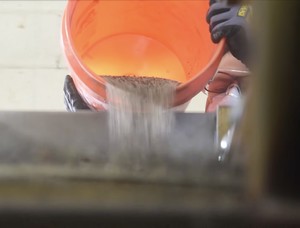
A key challenge in the process was recovering and cleaning the rubber infill material by separating it from sand and other debris.
Material Characterization
The process began with a sieve analysis to determine the particle size distribution:
-
Oversized material (large rocks): Retained above Mesh 8 (2380 microns)
-
Rubber infill: Primarily found between Mesh 8 and Mesh 18 (1000 microns)
-
Sand: Predominantly passed through Mesh 18
Initial Screening:
The material was first passed through a screening unit equipped with Mesh 8 and Mesh 18 screens. This step effectively removed oversized and undersized fractions, isolating the targeted rubber infill for further refinement.
Stoner Gravity Separation
The on-size fraction was then processed through a Triple/S Dynamics Stoner, which uses gravity separation to remove heavier materials (sand) from lighter materials (rubber).
A post-separation mesh analysis was conducted on the 8x18 mesh fraction to evaluate the effectiveness of the separation:
-
Minimal sand contamination was observed in the light fraction.
-
Some white particles originally suspected to be sand were identified as a mixture of rubber, plastic, and organic matter (grass & paper), which share similar densities with rubber and are therefore more difficult to separate through gravity alone.
Conclusion
The combination of sieve analysis, screening, and gravity separation using the Stoner proved highly effective. The process successfully removed the majority of unwanted materials, resulting in a clean rubber fraction with negligible sand contamination, demonstrating the Stoner’s value in complex recycling applications.