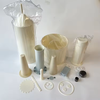
96% Alumina Substrate
96% Alumina (Al2O3) substrate is considered as one of the most cost-effective substrate materials. It possesses comprehensive properties of outstanding strength, good thermal conductivity, and stable electrical insulation. Another characteristic that makes it suited for both thin film and thick film metalization is its smooth surface. 96% alumina substrate is widely utilized in LED packages, chip resistor substrates, HIC substrates for heat dissipation, high-frequency power electronics, and other applications.
- Good surface roughness and can be polished to achieve mirror-like effect;
- Fast delivery, cost-effective, and the performance is stable;
- Fast heat dissipation, no hot spots left on the board device;
- No warping or bending in hot environments;
- Stable insulation performance, high resistivity, low dielectric constant;
- No moisture absorption issues occur, allowing it to be an excellent choice for marine and automotive power electronics applications.
99.6% Alumina Substrate
The standard for thin-film substrates is 99.6% alumina, which is frequently utilized for sputtering, evaporation, and chemical vapor deposition of metals to create circuits. The material is smoother and has fewer surface flaws thanks to the high purity of 99.6% alumina and the smaller grain size, resulting in a surface roughness of Ra0.1-0.3um. 99.6% alumina provides excellent electrical insulation, low thermal conductivity, great mechanical strength, outstanding dielectric characteristics, and good resistance to wear and corrosion.
Aluminum Nitride Substrate
Aluminum Nitride (AlN) substrate is an outstanding material that not only meets the requirements of high thermal conductivity but is also electrically insulating. It can swiftly disperse heat to keep electrical systems operating at their peak efficiency. Furthermore, unlike Beryllium Oxide (BeO), AlN substrate is safe to manufacture and machine. Additionally, its coefficient of thermal expansion is comparable to that of silicon material, although it performs better at high temperatures and heat dissipation than silicon. All of these features contribute to the widespread use of aluminum nitride substrate in power and electronics applications. It is particularly useful as a circuit substrate in semiconductors, LED lighting technologies, or high-power electronics.
- Fast heat dissipation
- No softening or distortion when running at a high temperature
- Low thermal expansion coefficient, which is similar to that of silicon
- Excellent plasma resistance
- Excellent resistance to thermal shock
Silicon Nitride Substrate
The remarkable mechanical, thermal, and electrical properties of silicon nitride substrate make it a valuable material for a variety of applications. In the semiconductor and electronics sectors, as well as in cutting-edge engineering and research fields, silicon nitride substrates are frequently employed. They are ideal for integrated circuit packaging and high-temperature sensors because they exhibit high thermal conductivity, superior electrical insulation, thermal shock resistance, and mechanical durability. Silicon nitride substrates are essential in contemporary technology and manufacturing processes because of their versatility.
Metalized Ceramic Substrate
Ceramic substrates can be metallized through various techniques, and several common methods include Direct Bonded Copper (DBC), Direct Plated Copper (DPC), and Active Metal Brazing (AMB).
DBC Ceramic Substrate
Direct Copper Bonding (DBC) ceramic substrate is a new composite material that consists of a copper metal coating on a highly insulating aluminum oxide (Al2O3) or aluminum nitride (AlN) ceramic substrate. The copper metal is oxidized and diffused by high-temperature heating to generate a eutectic melt with the ceramic, resulting in metal bonded ceramic substrates; and lastly, circuit substrates are produced. They are primarily used in high-temperature gaskets, chilling plate, and packaging of power semiconductor modules.
DPC Ceramic Substrate
Directly plated copper (DPC) ceramic substrate involves the process of coating a high-insulating ceramic substrate with copper metal using magnetron sputtering, followed by etching circuit patterns on the ceramic substrate through activation sputtering, and exposure and development. The combination of metal and ceramic is thickened through electroplating, and the line precision is increased while the line distance is decreased. The DPC ceramic substrates are commonly used in industries including semiconductor equipment, microwave wireless communications, and high-brightness and high-power LEDs.
AMB Ceramic Substrate
Active metal brazing substrate (AMB) is a method of welding on ceramics using active metals. The AMB substrate is made of insulating ceramic or silicon nitride (Si3N4), and a high-temperature vacuum welding technique is used to weld pure copper to the ceramic. It is possible to generate metal-ceramic composite materials with stable mechanical characteristics and excellent thermal conductivity, which are mostly utilized in electronic components and circuits with high demand.
Applications of Ceramic Substrate
- Sintering equipment
- Ceramic package of automotive electronics
- High-temperature heating element
- Substrate for chip resistors
- HIC substrates for heat dissipation
- Power modules
- Integrated circuit package
- Semiconductor manufacturing devices
- High-frequency circuits
- LED package
- Wafer bonding
- Optical module submount
- Ferrite microstrip circuit