Si3N4 Silicon Nitride Ceramic Substrates
Featured Product from Xiamen Unipretec Ceramic Technology Co., Ltd.
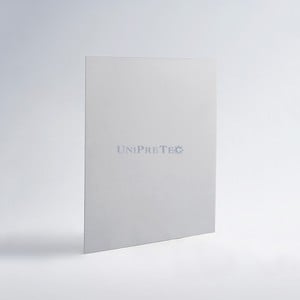
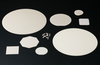
Silicon nitride ceramic substrate is a high-performance ceramic material with Si?N? as the main component, with high strength, high thermal conductivity, wear resistance, and excellent insulation. It is made by casting, sintering, and other processes, with controllable thickness (0.25 mm-1.00 mm) and a smooth surface. It is widely used in new energy vehicle SiC modules, 5G equipment, etc., and can efficiently dissipate heat and withstand high temperature and high pressure. It has both mechanical and electrical properties and is a key material in the field of high-end electronic packaging, balancing performance and mass production requirements.
Features
Mechanical properties
- High strength: Silicon nitride ceramic substrate has high strength and hardness, and its bending strength is usually higher than that of alumina substrate. For example, the bending strength of hot-pressed silicon nitride can reach 800 MPa or even higher and can withstand large external forces and mechanical stresses.
- High hardness: High hardness makes it wear-resistant and not easy to be worn or scratched. It is suitable for occasions that require long-term use and high surface quality requirements, such as mechanical parts, cutting tools, etc.
- Good toughness: Compared with other ceramic materials, silicon nitride has better fracture toughness and is not prone to brittle fracture, which improves the reliability and stability of use.
Thermal properties
- High thermal conductivity: The thermal conductivity is relatively high, generally between 80-90W/(m·K). Different preparation processes and conditions will lead to differences in thermal conductivity. Good thermal conductivity helps to quickly dissipate heat in high-temperature environments and can effectively reduce the operating temperature of electronic equipment.
- Low expansion coefficient: The thermal expansion coefficient is low, which is close to semiconductor silicon materials and third-generation semiconductor silicon carbide crystals. For example, its thermal expansion coefficient is (2.8-3.2)×10??/?, which can maintain dimensional stability in environments with large temperature changes and reduce deformation and cracking caused by thermal expansion or contraction.
- Good thermal stability: It can still maintain good mechanical properties and structural stability at high temperatures, can withstand temperatures of 1200? or even higher, and can withstand frequent thermal shocks. It can maintain stable performance after repeated heating and cooling from 0? to 200? for 10,000 times.
Electrical Properties
- High insulation: It has extremely high insulation resistance, with a volume resistivity greater than 10¹?Ω·cm, which can effectively isolate different parts of the circuit, prevent leakage and short circuit problems, and ensure the safe operation of electronic equipment.
- Low dielectric loss: Under high-frequency electric fields, the dielectric loss is low, which can reduce energy loss during signal transmission and ensure the transmission quality of signals. It is suitable for high-frequency and high-speed electronic devices.
Chemical Properties
- Strong corrosion resistance: It has good corrosion resistance to chemical substances such as acids, alkalis, and salts; is not easily eroded and corroded; and can be used in harsh chemical environments to extend its service life.
- Good oxidation resistance: It has good oxidation resistance at high temperatures, can resist oxygen erosion, and maintain the stability of the material performance.
Manufacturing Process
Tape casting is an important molding technology for preparing silicon nitride (Si?N?) ceramic substrates, especially suitable for producing thin, flat, precise-sized, and excellent-surface-quality substrates.
The core of the tape casting process is to mix silicon nitride ceramic powder with dispersants, binders, plasticizers, and other additives to prepare a uniform and stable slurry (slurry); then the slurry is evenly coated on a carrier film (such as PET film) through a doctor blade, and after drying and removing the solvent, a green tape with a certain strength is formed; finally, high-performance silicon nitride ceramic substrates are obtained through degreasing (removing organic additives) and sintering (densification).
Application field
- Semiconductor devices: As a substrate material for semiconductor chips, it provides support and electrical insulation for the chips and helps dissipate heat. It can be used to manufacture high-temperature electronic devices, microwave components, power devices, etc.
- Integrated circuit packaging: used for the packaging of integrated circuits, it can realize the electrical connection and mechanical fixation between the chip and the external circuit, protect the chip from the influence of the external environment, and improve the reliability and heat dissipation performance of the packaging.
- Electronic components: such as substrate materials of electronic components such as insulators, capacitors, resistors, etc., using their high insulation and good mechanical properties to ensure the normal operation and stability of the components.
- Power module: SiC power devices are the core components of the electric drive system of new energy vehicles. Si?N?-AMB ceramic substrates are the packaging substrates of SiC power devices. They have high thermal conductivity, high mechanical strength, and good thermal matching, which can meet the requirements of new energy vehicles for high reliability and high heat dissipation performance of power modules.