
PID Control Web Tension Indicators
Last Updated: April 1, 2025
Description
PID Control Web Tension Indicators are devices used to monitor and regulate the tension of a web, which is a continuous flexible material such as paper, film, or foil, during its processing. These indicators ensure that the tension remains within specified limits to prevent defects and maintain product quality.
Working Principle
PID Control Web Tension Indicators operate using a three-function algorithm known as proportional, integral, and derivative (PID) control. This control method requires real-time feedback from the system to adjust the tension accurately. The PID controller continuously calculates an error value as the difference between a desired setpoint and a measured process variable. It then applies a correction based on proportional, integral, and derivative terms, which helps in maintaining the desired tension by adjusting the control output. This method is useful because it provides precise control over the tension, reducing the risk of material defects and improving the overall efficiency of the web processing system.
Applications
PID Control Web Tension Indicators are commonly used in industries where precise tension control is critical. For example, in the printing industry, they ensure that paper or film is fed through the press at a consistent tension, preventing misalignment and print defects. In the packaging industry, they help maintain the correct tension of plastic films during the wrapping process, ensuring that the packaging is tight and secure. Additionally, they are used in textile manufacturing to control the tension of fabrics during weaving or dyeing processes.
Advantages over other Web Tension Indicators
One of the main advantages of PID Control Web Tension Indicators is their ability to provide precise and stable tension control through real-time feedback and adjustment. This is particularly beneficial in applications where the material properties or processing conditions may vary, as the PID controller can adapt to these changes and maintain consistent tension. Additionally, PID controllers can be integrated with advanced control strategies such as feedforward control and adaptive gain, further enhancing their performance and versatility.
Limitations
A limitation of PID Control Web Tension Indicators is that they require accurate and reliable feedback from the system to function effectively. If the sensors providing this feedback are not properly calibrated or maintained, the control system may not perform optimally. Additionally, PID controllers can be complex to set up and tune, requiring specialized knowledge and expertise to achieve the desired performance.
Considerations
When considering the implementation of PID Control Web Tension Indicators, it is important to evaluate the initial costs, which can be higher due to the need for precise sensors and control equipment. Operating expenses may also include regular maintenance and calibration of the sensors to ensure accurate feedback. However, the durability and accuracy of PID controllers can lead to long-term cost savings by reducing material waste and improving product quality. Replacement and maintenance costs should also be considered, as these can vary depending on the specific components used in the system.

from ABB Measurement & Analytics
MC 400 covers most mechanical arrangements. This means the user only has to follow the step-by-step instructions in order to set up the controller and to have a correct strip tension calculated. Predefined standard measurement modes. Prepared to calculate true strip tension from all mechanical... [See More]
- Control: Limit; Linear; PID
- Form Factor: Chassis
- Features: PLC
- Interface: Digital Front Panel; Computer Programmable
from Andantex USA, Inc.
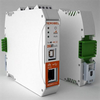
Specifically designed for multi-spindles tension control applications, DG-Block is the new benchmark in closed loop digital controller for any industries using equipment managing a large number of wires, cables, fibers or even narrow webs. Designed with the most advanced technologies, DGblock offers... [See More]
- Control: PID
- Control Signal: Analog Voltage Output
- Type: DC Voltage Inputs
- Web: Tension Indication/ Control

from FMS USA, Inc.
The CMGZ309 tension controller responses to a broad range of missions. Its field of application is in production lines where moving web products are manufactured, processed or finished. As a plug & play unit a minimum of tuning tasks are required. Functions can be configured very easily via a... [See More]
- Control: PID
- Interface: Digital Front Panel
- Form Factor: Chassis; DIN
- Inputs: 5