
Serial Ultrasonic Linear Position Sensors and Switches
Last Updated: April 1, 2025
Description
Serial Ultrasonic Linear Position Sensors and Switches are devices designed to detect and measure discrete distances to moving objects. They operate by using ultrasonic waves to determine the position of an object along a linear path. These sensors provide critical data for various engineering applications by delivering precise position information.
Working Principle
Serial Ultrasonic Linear Position Sensors work by emitting ultrasonic waves that travel through a medium and reflect off a target object. The sensor measures the time it takes for the waves to return, which is then used to calculate the distance to the object. This method is advantageous because it can operate effectively in environments where other sensing technologies might fail, such as in the presence of dust, moisture, or particle-laden air . The ability to measure discrete distances accurately makes these sensors useful for precise positioning tasks.
Applications
While specific applications for Serial Ultrasonic Linear Position Sensors are not detailed in the provided documents, ultrasonic sensors in general are often used in industrial automation, robotics, and automotive systems for tasks such as object detection, level measurement, and distance monitoring.
Advantages over other Ultrasonic Linear Position Sensors and Switches
The specific advantages of Serial Ultrasonic Linear Position Sensors over other ultrasonic sensors are not detailed in the provided documents. However, ultrasonic sensors generally offer the benefit of non-contact measurement, which reduces wear and tear and increases the longevity of the sensor.
Limitations
The documents do not provide specific limitations for Serial Ultrasonic Linear Position Sensors. However, common limitations of ultrasonic sensors include potential interference from environmental factors such as temperature variations and the need for a clear path between the sensor and the target object.
Considerations
When considering Serial Ultrasonic Linear Position Sensors, factors such as initial costs, operating expenses, durability, accuracy, and maintenance costs should be evaluated. Ultrasonic sensors typically have low maintenance costs due to their non-contact nature, but initial costs can vary based on the complexity and specifications of the sensor. Durability is generally high, but accuracy can be affected by environmental conditions, which should be taken into account during selection and installation.

from STEGO
The compact distance smart sensor determines the distance to objects using ultrasonic waves and the principle of time-of-flight measurement (ToF). It is suitable for numerous applications in the areas of distance and level monitoring. In contrast to other distance measuring methods (e.g., measuring... [See More]
- Interface: Serial
- Accuracy: 2
- Measurement Range: 11.81 to 157
- Resolution: 1
from Automation24, Inc.
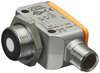
The UGT592 cube-shaped ultrasonic sensor from ifm electronic with a transducer frequency of 300 kHz, NO/NC programmable switching output, has a range of 40-300 mm. The ultrasonic sensor UGT592 is easy to place into operation with the help of the programming buttons. Its high protection rating of... [See More]
- Interface: Serial
- Sampling Frequency: 0.3000
- Measurement Range: 1.57 to 11.81
- Operating Temperature: -4 to 158
from Baumer Ltd.
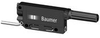
Most ultrasonic sensors are based on the principle of measuring the propagation time of sound in the air. Ultrasonic frequencies outside the range of human hearing are emitted by the sensor. Sonic energy reflected by an object or target is picked up by the sensor ’s receiver. The highly... [See More]
- Interface: Serial
- Sampling Frequency: 380
- Measurement Range: 0.1181 to 5.91
- Operating Temperature: 0.0 to 140
from Automation24, Inc.
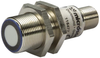
The pico+100/F M18 cylindrical ultrasonic sensor from microsonic, with a transducer frequency of 200 kHz and a PNP/NPN switching output that is programmable as NCC or NOC, has an operating range of 120-1,000 mm. NC/NO and rising/falling analog characteristics can be set via pin 5 by means of the... [See More]
- Interface: Serial
- Sampling Frequency: 0.2000
- Measurement Range: 4.72 to 39.37
- Operating Temperature: -13 to 158
from Baumer Ltd.
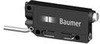
Most ultrasonic sensors are based on the principle of measuring the propagation time of sound in the air. Ultrasonic frequencies outside the range of human hearing are emitted by the sensor. Sonic energy reflected by an object or target is picked up by the sensor ’s receiver. The highly... [See More]
- Interface: Serial
- Sampling Frequency: 380
- Measurement Range: 1.18 to 7.87
- Operating Temperature: 0.0 to 140

from Automation24, Inc.
The pico+100/WK/F M18 cylindrical ultrasonic sensor from microsonic, with a transducer frequency of 200 kHz and a PNP/NPN switching output that is programmable as NC or NO, has an operating range of 120-1,000 mm. NC/NO and rising/falling analog characteristics can be set via pin 5 by means of the... [See More]
- Interface: Serial
- Sampling Frequency: 0.2000
- Measurement Range: 4.72 to 39.37
- Operating Temperature: -13 to 158
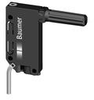
from Baumer Ltd.
Most ultrasonic sensors are based on the principle of measuring the propagation time of sound in the air. Ultrasonic frequencies outside the range of human hearing are emitted by the sensor. Sonic energy reflected by an object or target is picked up by the sensor ’s receiver. The highly... [See More]
- Interface: Serial
- Sampling Frequency: 380
- Measurement Range: 0.1181 to 5.91
- Operating Temperature: 0.0 to 140