
Friction Material Friction Materials
Description
Friction materials are specialized substances designed to create resistance between two surfaces in contact. They are essential in controlling motion and ensuring stability by converting kinetic energy into heat through friction. These materials are typically applied to components such as brake pads or shoes, where they help manage the speed and stopping power of moving parts.
Working Principle
Friction materials operate by utilizing their inherent properties to generate friction when two surfaces slide against each other. The effectiveness of a friction material is largely determined by its coefficient of friction, which dictates the retarding force produced. This force is calculated using the equation:
latex
F_{\text{friction}} = \mu N
where ( \mu ) is the coefficient of friction and ( N ) is the normal force applied. The materials are engineered to withstand high temperatures and pressures, making them crucial in applications where controlled deceleration is necessary. Their ability to dissipate energy as heat makes them invaluable in maintaining the efficiency and safety of mechanical systems.
Applications
Friction materials are widely used across various industries. In the automotive sector, they are integral to the function of disc and drum brakes, providing the necessary friction to slow down or stop vehicles. In the military and manufacturing industries, these materials are used in machinery and equipment to ensure precise control and safety. Additionally, they find applications in mining operations, where they help manage the movement of heavy machinery.
Advantages over other Friction Materials
Friction materials can be categorized into non-metallic, semi-metallic, and sintered metal types, each offering distinct advantages. Non-metallic materials, such as those made from cellulose or aramids, minimize rotor wear, although they may have shorter service lives. Semi-metallic materials, which include metallic flakes, offer improved wear resistance and longer service life, albeit with increased wear on the rotor or drum. Sintered metal pads provide the highest energy capacity, making them suitable for high-demand applications.
Limitations
One of the primary limitations of friction materials is their heat dissipation capacity. For instance, drum brakes, which are covered by lining, rely on the drum to conduct heat to the outside air, which can be inefficient. Additionally, non-metallic linings, while reducing rotor wear, tend to have shorter service lives. The uneven wear of friction linings in certain brake types, such as band brakes, can also pose challenges.
Considerations
When selecting friction materials, several factors must be considered. Initial costs can vary significantly depending on the material type, with organic materials generally being less expensive than semi-metallic or sintered options. Operating expenses are influenced by the material's durability and wear rate, with more durable materials often resulting in lower long-term costs. Maintenance and replacement costs are also critical, as materials with shorter service lives may require more frequent replacements, increasing overall expenses. Durability and accuracy in performance are essential for ensuring the safety and efficiency of the systems in which these materials are used.
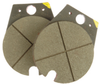
from Dover Flexo Electronics, Inc.
Dover Flexo Electronics, Inc (DFE) has the solution to problem brake squeal. Part of the solution is to ensure that brakes are properly installed and aligned for the web application and individual running conditions on a machine. Then, if improper installation doesn't seem to be the root cause of a... [See More]
- Form: Friction Material
- Industry / Application: Brakes