Alert   Product Alerts
Keep current on the latest products, new suppliers, and technical articles of interest to you. (See Topics)

Chapter 7 - Temperature Measurement: Filled-System Thermometers

By Thomas A. Hughes
From Measurement and Control Basics Fourth Edition

Many physical properties change with temperature, such as the volume of
a liquid, the length of a metal rod, the electrical resistance of a wire, the
pressure of a gas kept at constant volume, and the volume of a gas kept at
constant pressure. Filled-system thermometers use the phenomenon of
thermal expansion of matter to measure temperature change.

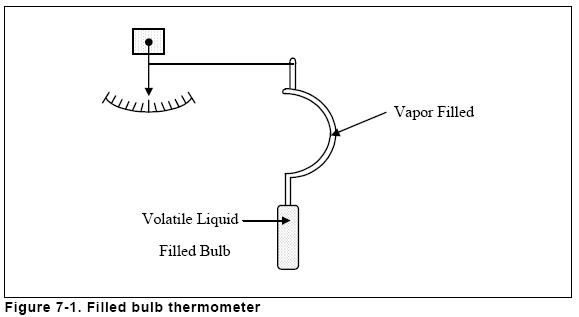
The filled thermal device consists of a primary element that takes the form
of a reservoir or bulb, a flexible capillary tube, and a hollow Bourdon tube
that actuates a signal-transmitting device and/or a local indicating temperature
dial. A typical filled-system thermometer is shown in Figure 7-1.
In this system, the filling fluid, either liquid or gas, expands as temperature
increases. This causes the Bourdon tube to uncoil and indicate the
temperature on a calibrated dial.

Figure 7-1. Filled bulb thermometer

The filling or transmitting medium is a vapor, a gas, mercury, or another
liquid. The liquid-filled system is the most common because it requires a
bulb with the smallest volume or permits a smaller instrument to be used.

The gas-filled system uses the perfect gas law, which states the following
for an ideal gas:

 T = kPV(7-5)

where:   
 T=temperature
 k=constant
 P=pressure
 V=volume

If the volume of gas in the measuring instrument is kept constant, then the
ratio of the gas pressure and temperature is constant, so that

 (7-6)

The only restrictions on Equation 7-6 are that the temperature must be
expressed in degrees Kelvin and the pressure must be in absolute units.

Example 7-3 shows how to calculate the temperature for a change in pressure
of a fixed volume temperature detector.


© 2007 ISA

Products & Services
Pressure sensors include all sensors, transducers and elements that produce an electrical signal proportional to pressure or changes in pressure. Search by Specification | Learn more about Pressure Sensors
Temperature instruments use contact or noncontact methods to measure temperature. Products include dial, digital, industrial and laboratory thermometers; temperature probes, indicators, and sensors; RTD elements and transmitters; and thermistors, thermocouples, thermopiles, and thermal switches.  Search by Specification | Learn more about Temperature Instruments
Resistive temperature device (RTD) elements are wire windings or other thin-film serpentines that exhibit changes in resistance with changes in temperature. They are usually made of metallic elements or alloys such as copper, nickel, or nickel-iron. Search by Specification | Learn more about Resistive Temperature Devices (RTD) Elements
Level sensors are used to detect liquid or powder levels, or interfaces between liquids. There are two basic level-measurement types: continuous and point or multi-point. Search by Specification | Learn more about Level Sensors
Noncontact infrared temperature sensors absorb ambient infrared (IR) radiation given off by a heated surface. They are used in applications where direct temperature measurement is not possible. Search by Specification | Learn more about Noncontact Infrared Temperature Sensors

Product Announcements
Palmer Wahl Instrumentation Group - Direct Drive Remote Reading Dial Thermometer
3 ½" Direct Drive Remote Reading Dial Thermometer Flush mounted model. Fully adjustable all angle case awith Rotatable Dial Face or optional Fixed Back Connected. Type 302 Staninless Steel Case. (read more)
Palmer Wahl Instrumentation Group - Rigid Dial Thermometer Mercury Actuated
Direct-Drive Double-Wound Bourdon Coil With this type of construction, the pointer shaft operates directly from the center coil. This eliminates the conventional sector and pinion type movement and... (read more)
Jordan Valve Group - Mark 80 Temperature Regulators
The Mark 80 Series is completely self-operated and requires no external power source or other expensive instrumentation to operate the valve. (read more)
QED, Inc. - Bourdon tube pressure gauges
QED manufactures precision helically wound Bourdon tube pressure gauges, pressure switches and pressure gauge/switch combinations for a wide range of demanding applications. The Bourdon tube design... (read more)
Conax Technologies - Split Packing Glands (Model SPG, DSPG and PGS)
Conax provides split and double split packing glands for multiple probe sealing. Split glands are used whenever the diameter of the probe tip exceeds the diameter of the surface to be sealed (i.e. (read more)
Acrolab Ltd. - Oil & Gas Temperature Sensors Thermocouples & RTDs
Recent high demand from the Oil & Gas industry has allowed Acrolab to apply its world recognized expertise in temperature sensing technology to this continually expanding market. The need for... (read more)
Kin-Tek Laboratories Inc. - FlexStream Gas Standards Generator
KIN-TEK's new FlexStream™ automated gas standards generating instrument offers flexibility for creating precision gas mixtures. Mixtures are produced by diluting the emission from permeation... (read more)
 

Topics of Interest
A bimetallic strip curves or twists when exposed to a temperature change, as Figure 7-2 shows, because of the different thermal expansion coefficients of the metals used in it. Bimetallic... (Read More)
Attenuators Many times we are faced with the problem of needing a particular voltage for an application but the signal generator (or any other source) will not produce the desired voltage level. ... (Read More)
The density of gases can vary greatly with changes in both temperature and pressure. The Ideal Gas Law incorporates Charles’ and Boyle’s Laws and also the concept of molecular weight. (Read More)
Deflection gauges measure true pressure via deflection of a bourdon tube, independent of the type of gas in a system. Bourdon tubes are constructed in either C-tube or helical coil geometries and of... (Read More)
5-5. Control Errors The peak error is rather large for fast disturbances due to a time constant to dead time ratio that ranges from poor (e.g., 4.0) to lousy (e.g., 0.4). The larger ratios correspond... (Read More)
See more product announcements for Pressure Sensors
New Intrinsically Safe Pressure Sensor Brochure

New Intrinsically Safe Pressure Sensor Brochure
PCB Piezotronics, Inc.


FUTEK USB Sensor Solution

FUTEK USB Sensor Solution
Futek Advanced Sensor Technology, Inc.


Pressure Sensors–Gen Purp, Differential, Miniature

Pressure Sensors–Gen Purp, Differential, Miniature
Honeywell Sensing and Control / Sensors for Test & Measurement


11 See more product announcements for Pressure Sensors