Go to GlobalSpec.com Home
Alert   Product Alerts
Keep current on the latest products, new suppliers, and technical articles of interest to you. (See Topics)

Chapter 7 - Temperature Measurement: Four-Wire Resistance Measurement

By Thomas A. Hughes
From Measurement and Control Basics Fourth Edition

The Wheatstone bridge method of measuring the resistance of an RTD has
certain problems associated with it. These problems are solved by the
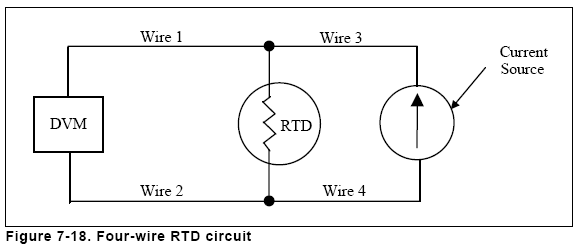
technique of using a current source along with a remotely located DVM,
as shown in Figure 7-18. The output voltage read by the DVM is directly
proportional to RTD resistance, so you only need one conversion equation
to convert from resistance to temperature. The three bridge resistors are
replaced by one RTD. The digital voltmeter measures only the voltage
dropped across the RTD and is insensitive to the length of the lead wires.

Figure 7-18. Four-wire RTD circuit

One disadvantage of a four-wire system is that, obviously, it requires one
more wire than a three-wire bridge. However, this is a small price to pay
given the increased accuracy of the temperature measurement it provides.

Resistance to Temperature Conversion

The RTD is a more linear device than the thermocouple, but it still requires
curve fitting to yield a more precise reading. The Callendar-Van Dusen
equation has been used for years to approximate the platinum RTD curve:

 (7-10)

where   
 
R
=resistance at temperature T
 
Ro
=resistance at T = 0°C
 
α and δ
=constants
β
=0 if T > 0, or β is 0.1 (typical) if T < 0

You determine the exact values for coefficients α, β, and δ by testing the
RTD at four temperatures and then solving the resulting equations. Typical
values for platinum RTDs are as follows:


Example 7-7 illustrates a typical calculation to obtain the resistance ratio
for a platinum RTD.

EXAMPLE 7-7

Problem: Calculate the resistance ratio for a platinum RTD with α = 0.00392 and δ = 1.49 when T = 100°C.

Solution: Since T is greater than 0°C, β = 0, the Callendar-Van Dusen
equation reduces to the following:

So,


© 2007 ISA

Products & Services
Pressure sensors include all sensors, transducers and elements that produce an electrical signal proportional to pressure or changes in pressure. Search by Specification | Learn more about Pressure Sensors
Temperature instruments use contact or noncontact methods to measure temperature. Products include dial, digital, industrial and laboratory thermometers; temperature probes, indicators, and sensors; RTD elements and transmitters; and thermistors, thermocouples, thermopiles, and thermal switches.  Search by Specification | Learn more about Temperature Instruments
Resistive temperature device (RTD) elements are wire windings or other thin-film serpentines that exhibit changes in resistance with changes in temperature. They are usually made of metallic elements or alloys such as copper, nickel, or nickel-iron. Search by Specification | Learn more about Resistive Temperature Devices (RTD) Elements
Level sensors are used to detect liquid or powder levels, or interfaces between liquids. There are two basic level-measurement types: continuous and point or multi-point. Search by Specification | Learn more about Level Sensors
Noncontact infrared temperature sensors absorb ambient infrared (IR) radiation given off by a heated surface. They are used in applications where direct temperature measurement is not possible. Search by Specification | Learn more about Noncontact Infrared Temperature Sensors

Product Announcements
Temperature Specialists, Inc. - Platinum Wirewound Resistance Temperature Detector
Platinum wire wound Resistance Temperature Detectors (RTD) construction consists of very fine high purity Platinum wire wound onto a ceramic core and then hermetically sealed with a glassed coating. (read more)
Tempco Electric Heater Corporation - Industrial Accu-ohm™ RTD's - Style R4 Connection
Tempco's RTD's (Resistance Temperature Detectors) are designed to meet IEC Publication 751, DIN43760, JIS1604-1989 and BS1904-1984. They are normally supplied to Class B, but can be manufactured to... (read more)
Sensor Scientific, Inc. - Platinum Thin Film RTD Elements
Sensor Scientific, Inc. Platinum Thin Film RTD Elements are fabricated using state-of-the-art thin film processing techniques, resulting in an element of exceptional quality and stability. The wide... (read more)
Spectrum Sensors and Controls - Thin Film Resistance Temperature Detectors
Spectrum Sensors & Controls has developed a line of Resistance Temperature Detectors (RTDs) using thin film technology that provides excellent sensing at a lower cost than wire wound elements. (read more)
Temperature Specialists, Inc. - Fast Response Hollow Elements
Hollow elements are designed for faster time response to temperature changes over the range of -100 to +260 degrees C. They are wire wound Resistance Temperature Detectors (RTD's) made using Copper,... (read more)
Automationdirect.com - Temperature Sensors, Switches, Probes, Thermowells
Monitoring and controlling temperature is essential in processing and industrial automation applications. AutomatinDirect offers temperature switches, RTD probes, analog temperature transmitters and... (read more)
Fluke Corporation, Hart Scientific Division - 1575A and 1590 Super-Thermometer Readouts
Hart's Super-Thermometers are recognized in metrology laboratories around the world for their ease of use and reliable accuracy. The Model 1575A Super-Thermometer is accurate to 0.001 °C. The Model... (read more)
 

Topics of Interest
Like the RTD, the thermistor is also a temperature-sensitive resistor. The name thermistors is derived from the term “thermally sensitive resistors,” since the resistance of the... (Read More)
In the newest construction technique, a platinum or metal-glass slurry film is deposited or screened onto a small flat ceramic substrate. It is then etched with a laser-trimming system and sealed... (Read More)
You cannot measure the Seebeck voltage directly because you must first connect a voltmeter to the thermocouple, and the voltmeter leads create a new thermoelectric circuit. Consider a digital... (Read More)
A bimetallic strip curves or twists when exposed to a temperature change, as Figure 7-2 shows, because of the different thermal expansion coefficients of the metals used in it. Bimetallic... (Read More)
In principle, any material could be used to measure temperature if its electrical resistance changes in a significant and repeatable manner when the surrounding temperature changes. In practice,... (Read More)
See more product announcements for Pressure Sensors
Pressure Sensors–Gen Purp, Differential, Miniature

Pressure Sensors–Gen Purp, Differential, Miniature
Honeywell Sensing and Control / Sensors for Test & Measurement


New Intrinsically Safe Pressure Sensor Brochure

New Intrinsically Safe Pressure Sensor Brochure
PCB Piezotronics, Inc.


FUTEK USB Sensor Solution

FUTEK USB Sensor Solution
Futek Advanced Sensor Technology, Inc.


11 See more product announcements for Pressure Sensors