Bio-Based Polymers and Composites

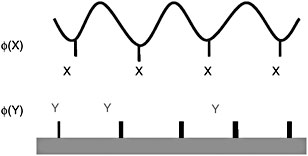
When using sticker groups X to adhere linear chains of length M to solid substrates such as natural fiber, glass, or metal and which may contain receptor groups Y, as shown in Figure 6.15, some very interesting effects occur [83 85]. There exists an optimal number of both receptor X-groups and acceptor Y-groups to obtain maximum adhesion at the polymer solid interface. The optimal number of X-groups is only about 3 %, whereas the optimal number of Y-groups on the solid is closer to 50%. We believe these results are a balance between the connectivity of the first layer of chains to the solid substrate and the ability of this first layer to be connected to the polymer bulk above the substrate. If the polymer is too well adhered to the substrate and adopts a flat conformation, it may not be well connected to the polymer layer above, with a resultant loss of interface strength. This leads to many new concepts of adhesion design, which can be understood in terms of molecular connectivity and percolation concepts.
Lee and Wool [83, 84] and Gong and Wool [85 87] conducted experiments to investigate the influence of a small number of sticker groups ( ? X)...