Modelling Control Systems Using IEC 61499: Applying Function Blocks to Distributed Systems

Basic function blocks can be described either textually using the IEC 61499 textual syntax or graphically. There are two graphical representations that together depict the properties and behaviour of a basic function block: (i) the external interface declaration and (ii) the execution control chart (ECC) that defines the relationships between events, states and algorithm execution.
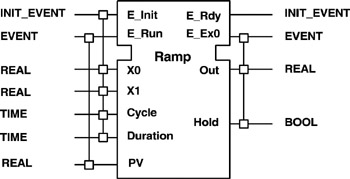
The external interface declaration as shown in Figure 3.2 has the following features:
The function block type name should be positioned in the centre of the main block as shown by Ramp in Figure 3.2. Inputs to the block are always shown on the left of the block; outputs are shown coming from the right side of the block.
Input events are depicted entering the left side of the upper part of the block, output events are shown coming from the right.
The names of input and output variables are shown inside the block next to their associated graphical connectors.
The data types of inputs and outputs are shown at the left hand and right hand ends of the graphical connectors respectively.
The graphical representation provides sufficient information to be used as a formal type declaration. In fact, a primary objective of IEC 61499 is that graphical representations always have a precise textual representation. It is envisioned that graphical modelling tools will always be able to convert graphical forms into textual representations and vice-versa.
Input events such as the E_Init event...