Modelling Control Systems Using IEC 61499: Applying Function Blocks to Distributed Systems

Appendix D: PID Function Block Example

Overview

This Appendix depicts how a Proportional, Integral and Derivative (PID) algorithm can be encapsulated as a composite function block.

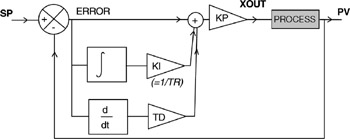
A PID algorithm is used in closed loop control where there is a requirement to control a process that may be subject to disturbances caused by external factors or by unpredictable changes to the process. Examples are: to control the temperature of a heat treatment oven where the internal temperature has to remain stable while the oven door is opened and different loads are inserted into the oven, or to control the pressure in a reactor vessel while a chemical reaction is progressing. The PID algorithm uses the error between the current process value (PV) and the desired process value or setpoint (SP), along with the integral and derivative values of the error, to calculate a new output value to drive the process. This output value is used to drive an actuator to, say, adjust the current in a heater or change a pump speed in order to bring the process value closer to the setpoint. A PID algorithm has a number of parameters that must be tuned to match the process under control. This is required to ensure that the control action is responsive and has minimum overshoot. An application using a PID is discussed in the beginning of chapter 6. The main features of the PID algorithm are shown in Figure D.1.


Figure D.1: PID algorithm
Note

this example is intended to demonstrate the use of IEC 61499...

UNLIMITED FREE
ACCESS
TO THE WORLD'S BEST IDEAS

SUBMIT
Already a GlobalSpec user? Log in.

This is embarrasing...

An error occurred while processing the form. Please try again in a few minutes.

Customize Your GlobalSpec Experience

Category: Temperature Controllers
Finish!
Privacy Policy

This is embarrasing...

An error occurred while processing the form. Please try again in a few minutes.