Introduction to Mobile Communications Engineering
A comprehensive and advanced introduction to the engineering and
design concepts for mobile communications systems.
 TABLE OF CONTENTS
 Teletraffic theory [1] is used to evaluate the number of lines required to link two switching offices with a specified quality or Grade of Service (GoS) expressed in terms of the blocking probability p. The total offered traffic A, the number of lines N, and the blocking probability p are related through the well-known Erlang-B formula
| (8.1) |  |
| (8.2) | 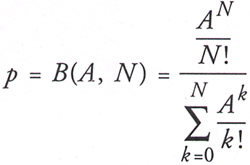 |
This formula is also used for radio systems. To illustrate the concept and the gain obtained by a trunked radio system with respect to a set of individual systems, a comparison is made between a system in which all communications are served by a single N-channel radio system and the case in which there exist N single-channel systems, each serving its own traffic ( A/ N). In both cases the same blocking probability p is assumed. A can be calculated using the expression
| (8.3) | 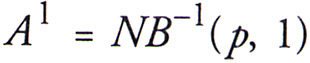 |
Comparing both results, it is clear that A is greater than A 1 for N > 1. This is due to the nonlinearity of the Erlang formula.
It can be concluded that it is far more efficient to offer the whole traffic demand to a set of channels (trunked system) than to split the traffic and offer it to individual single-channel systems (Figure 8.1). The traffic-handling capability increment (trunking gain) is also apparent when the traffic per channel is...