UV lenses
Featured Product from Avantier Inc.
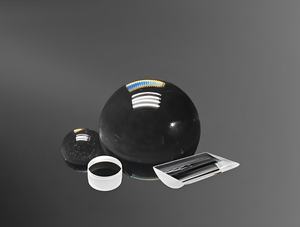
At Avantier produces custom UV lenses for applications involving ultraviolet light from 10 nm to 400 nm. UV lenses are specialized optical components designed for wavelengths below 400 nm, making them ideal for UV laser applications, focusing, and collimation. Depending on the design and substrate, our UV lenses can also support applications across the VIS, NIR, and IR spectra.
Applications of UV Lenses
UV lenses may be used for focusing ultraviolet light sources, for polychromatic illumination in fluorescence applications, for microlithography, spectroscopy, and laser fusion projects. From military and defense to industrial quality control and forensics, UV optics is a robust and rapidly growing field.
Special Considerations for UV Lenses
While UV lenses function similarly to other lenses, UV applications require special consideration due to the challenges associated with shorter wavelengths. Key factors include scattering, dispersion, and laser damage.
- Scattering: Scattering can occur when light encounters inhomogeneities or surface imperfections. To minimize it, choose UV lenses with low parasitic birefringence, a homogeneous refractive index, and highly polished surfaces.
- Dispersion: Many optical substrates exhibit stronger chromatic dispersion in the UV range than in the visible (VIS) and infrared (IR) regions. Achromatic optics can help reduce dispersion and chromatic aberration when needed.
- Laser Damage and Degradation: UV optics can have lower laser damage thresholds than optics designed for longer wavelengths. Two-photon absorption can contribute to UV-induced damage. For high-intensity applications, use lenses specifically designed for UV lasers and avoid exposing them to lubricant or oil vapors within intense UV beams.
Specifications
| Diameter Range | 10-50mm |
| Diameter Tolerance | +0/-0.1mm |
| Thickness Tolerance | +/-0.1mm |
| Surface Quality | 60-40 S-D |
| Power(Irregularity) | 3(0.5)fringes |
| Centering Tolerance | <3′ |
| Clear Aperture | 90% |